
A good cost per sale for an Australian solar installer in 2026 is $500 or less in ad spend for every signed job, and under $400 is achievable. Ask most solar installers how their ads are going, though, and you’ll hear a cost per lead. It’s the wrong number.
Last year, the benchmark we heard again and again from installers running their own ads was a cost per acquisition (CPA) of $500: $500 in ad spend for every signed sale. Most don’t hit it. Our estimate is that 70% to 80% of solar companies running their own ads end up above $500, and we’ve heard of installers paying as much as $2,000 per sale. Many go back to buying leads from marketplaces like SolarQuotes.
This guide is for owners and marketing managers of Australian solar installers who want to know what a good solar cost per sale looks like, why cheap leads are rarely the answer, and how the installers we work with get under $400 per sale.
What This Guide Covers
-
The metric that matters: cost per sale, not cost per lead
-
Why cheap solar leads cost more
-
Google Ads works, but it’s expensive
-
Why solar homeowners get 10 quotes
-
Batteries bring them in, and a whole system closes the sale
-
What good solar marketing looks like now
-
What it delivers
-
Why not just buy solar leads?
-
Check your own numbers
-
FAQ
Key Takeaways
-
Judge your ads on cost per sale (CPA). $500 is the benchmark; under $400 is achievable.
-
A typical installer closes 1 in 4 to 1 in 6 leads. At the extreme, we’ve heard of $20 leads needing 25 conversations per sale: on benchmark for ad spend, and a disaster for the sales team.
-
Homeowners are confused. Many collect 5 to 10 quotes because of crowded advertising and lead sellers running rebate offers.
-
The installers beating the benchmark educate homeowners before they enquire: branded Meta ads, a qualifying landing page and nurture that keeps them warm.
-
For our solar clients, that means $50 to $80 per qualified solar and battery lead, 1 in 3 to 1 in 6 closing, and a cost per sale under $400.
-
Batteries drive the enquiry, but more than 70% of homeowners also want a solar upgrade. They’re buying a whole system, worth anywhere from $12,000 to $50,000.
By Lakshane Fonseka, founder of Uprise Digital. Lakshane leads a Melbourne agency that has worked with more than 100 Australian businesses, including solar and battery installers, and previously worked at Accenture and KPMG.
The Metric That Matters: Cost Per Sale, Not Cost Per Lead
Cost per acquisition (CPA) is your total ad spend divided by the number of signed sales it produced. It’s the only number that captures both what each lead costs and how many of those leads go ahead. In this guide, CPA means ad spend only. It doesn’t include your sales team’s wages, commissions or the cost of the install.
A typical installer converts 1 in 4 to 1 in 6 leads into a sale. At a $500 CPA, that means a lead can cost roughly $80 to $125 and still hit the benchmark. That’s before your sales team’s time: every lead that doesn’t buy still takes a call, a quote and often a site visit.
Rule of thumb: if your team needs more than six leads to close one job, fix lead quality before you spend another dollar on volume.
Why Cheap Solar Leads Cost More
The obvious way to hit a $500 CPA is cheap leads. One installer running their own ads told us they were paying around $20 a lead and needing about 25 conversations to close one job. That’s an extreme case, but it shows the trap: 25 calls, 25 quotes and plenty of site visits for one sale. The ad spend hits the benchmark while the sales team drowns.
|
Cheap leads |
Google Ads |
Educated Meta leads |
|
|---|---|---|---|
|
Typical cost per lead |
$20 |
$100 to $200 |
$50 to $80 |
|
Leads needed per sale |
Around 25 |
4 to 6 |
3 to 6 |
|
Example cost per sale |
$20 × 25 = $500 |
$150 × 5 = $750 |
$65 × 4 = $260 |
|
Sales conversations per sale |
25 |
5 |
4 |
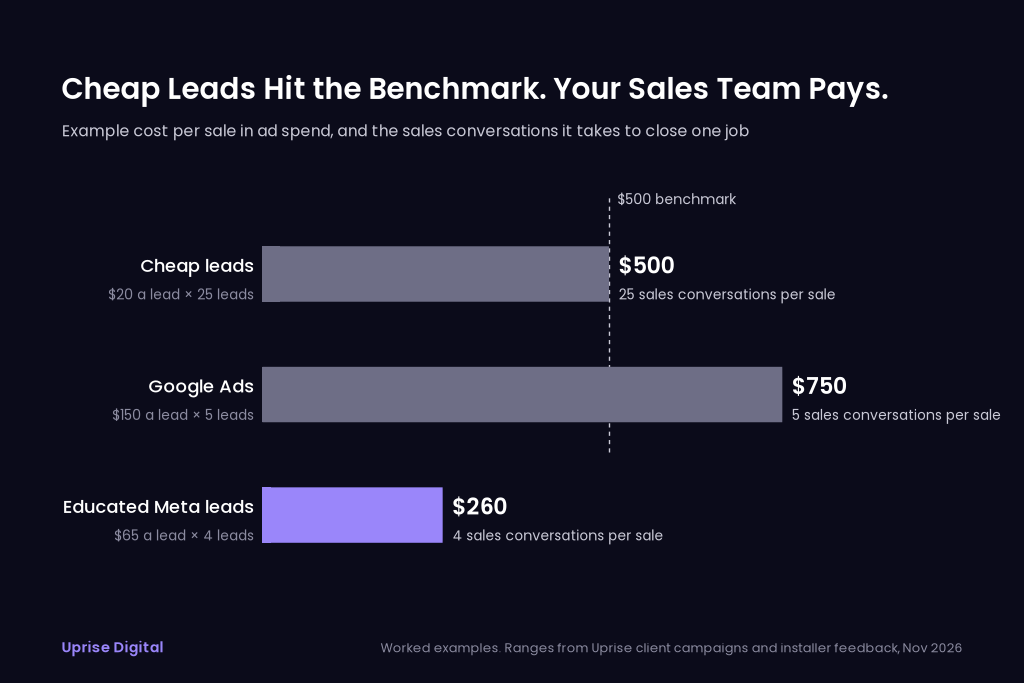
The cheap lead column is the extreme case above. The educated Meta column is a qualified solar and battery lead: a homeowner who knows what they want and has given your team the details it needs to quote.
The goal is a warm, well-educated lead with high intent to buy. Neither the cheapest lead nor the most expensive one gets you there on its own.
Google Ads Works, but It’s Expensive
Google catches homeowners who are actively looking, which is why it’s most installers’ first instinct. But Google’s cost per click goes up every year, and for most installers today a lead costs $100 to $200. Well dialled-in Google Ads campaigns for solar can still bring leads in at $65 to $130, mostly in less competitive markets like Canberra and regional New South Wales and Queensland.
Google’s own estimates show why. Here is what a click costs on the searches homeowners use, according to Google Ads estimates for Australia (September 2026):
|
Search |
Monthly searches |
Average cost per click |
|---|---|---|
|
solar panels |
40,500 |
$7.99 |
|
solar battery |
22,200 |
$13.48 |
|
solar panel installation |
8,100 |
$21.43 |
|
solar installer |
2,900 |
$21.03 |
|
solar battery installer |
2,400 |
$24.89 |
|
solar installers near me |
1,900 |
$20.25 |
|
solar panels perth |
2,900 |
$22.78 |
|
solar panels brisbane |
1,900 |
$20.70 |
|
solar panels sydney |
880 |
$17.43 |
|
solar panels melbourne |
1,600 |
$17.20 |
|
solar panels adelaide |
880 |
$16.98 |
|
solar panels canberra |
390 |
$12.63 |
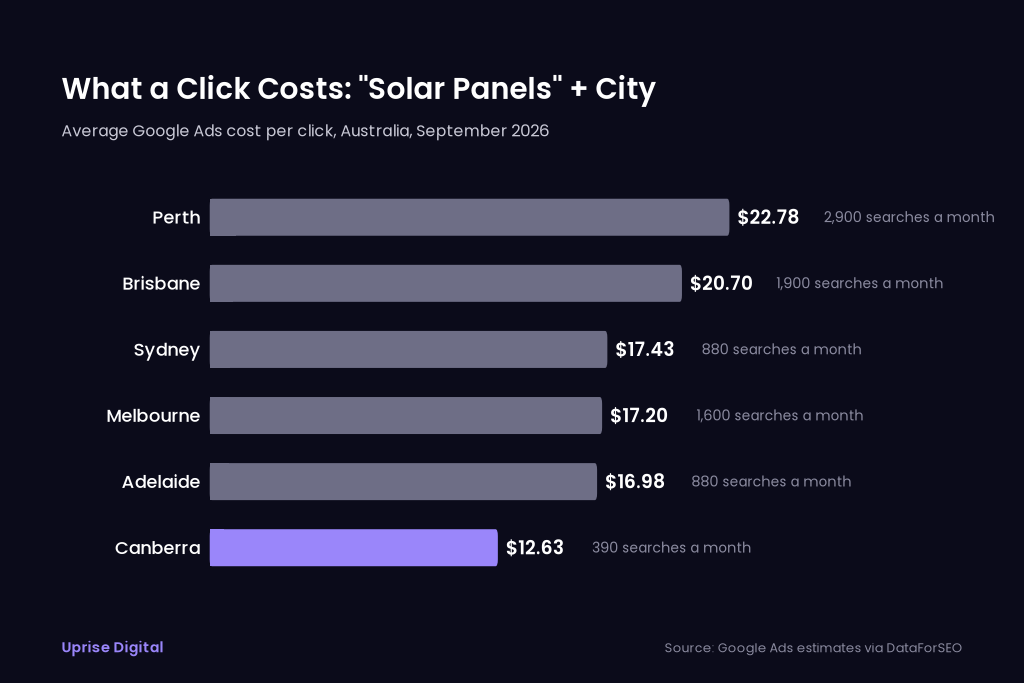
The searches with real buying intent, like “solar installer” and “solar battery installer”, cost $20 to $25 a click. As an example, if 10% to 15% of those clicks become an enquiry, each lead costs about $140 to $250. Canberra is the cheapest of the six capital-city searches above, which matches what we see in campaigns.
It comes down to the city, the competition, the service you’re selling and the timing, so check it against your own market. At four to six leads per sale, the maths gets hard quickly.
Why Solar Homeowners Get 10 Quotes
It’s common for homeowners to get 5 to 10 quotes before deciding. In some cities and states, installers tell us 10 is now the average. The market is crowded with advertisers, including third-party lead sellers running ads on rebates and “$4,000 battery” offers to collect cheap leads and sell them on. Many of those offers lean on the federal Cheaper Home Batteries Program, which has discounted home batteries since 1 July 2025.
The result is a homeowner who is confused and uneducated, comparing ten prices without knowing what makes one installer better than another. Put that homeowner in front of your sales team and the conversation is about price. Educate them first, and it’s about trust.
Batteries Bring Them In, and a Whole System Closes the Sale
The big demand right now is batteries. “Solar battery” alone gets 22,200 searches a month in Australia (Google Ads estimate, September 2026). But in our experience, more than 70% of homeowners who enquire about a battery also want their solar panels upgraded so the two work together. Very few buy a battery on its own.
Most don’t start out knowing that. Plenty think their existing panels are fine, or haven’t thought about how a battery fits with them. The battery offer mostly sped up homeowners who were already heading towards solar and storage.
What they buy into is a system designed around their household: how they use energy today, and how they’ll use it in the future. That’s why a sale can be anywhere from $12,000 to $40,000 or $50,000, depending on the house and the system. And it’s why education matters. A homeowner who understands this is comparing systems, and battery prices become one line in that comparison.
What Good Solar Marketing Looks Like Now
The installers beating the benchmark run a system. Each part does one job, and each part is measured.
1. Use Facebook and Instagram to Reach and Educate
Meta is cheaper than Google per lead, and it reaches homeowners before they’ve collected ten quotes. The ad’s job goes beyond the click. It starts the education: what a good system looks like, what to watch out for, and why your business is worth talking to. Our Facebook ads for solar companies page shows how we set this up.
2. Make Branded Creative That Builds Trust
-
Founder-led video: the owner explaining what they do differently, and why.
-
Team-led video: installers and sales staff on real jobs, answering real questions.
-
Educational statics: simple images that explain batteries, rebates or bill savings in plain language.
-
Retargeting: follow-up ads for people who watched, clicked or started a form, with reviews and case studies.
Branded campaigns outperform generic ones for a simple reason. When a homeowner has seen someone from your company on camera, received emails that look and sound like you, and kept seeing your ads while comparing quotes, trust is built before your salesperson calls or arrives on site. You’re already near the top of their list.
3. Send Every Ad to a Landing Page That Qualifies
Skip the homepage. Use a page built for that offer, asking what your sales team needs before they call: the property address, the household’s monthly power bill, when they want the job done, and their contact details. Review it every week: where people drop off, what they read, and which questions stop them filling in the form.
4. Nurture Every Lead Who Isn’t Ready Yet
Many homeowners won’t buy this month. An email sequence, a brochure and a useful PDF keep your brand in front of them while they compare, so when they’re ready, you’re the installer they already trust.
5. Optimise Every Stage, All the Time
The ad, landing page, form and follow-up are each tested against one question: what do customers want right now, where are they dropping off, and where are they finding value?
$50 to $80 per qualified solar and battery lead · 1 in 3 to 1 in 6 leads become sales · Under $400 cost per sale
What It Delivers
Those are the typical results for the solar installers we work with. The leads cost more than cheap ones, but they close, because by the time they enquire they already trust the brand, they’ve been educated by it, the landing page has qualified them, and the emails and retargeting have kept them warm.
For one of our clients, G-Solar, recent feedback is that their cost per sale through our campaigns is under $400. Their SolarQuotes leads cost them up to $500 per sale. We hear similar from other installers we work with.
A note on these numbers: they’re based on our clients’ results as at November 2026. They assume the market isn’t flooded with more installers, that the number of homeowners in the market stays roughly the same, and that Meta’s advertising costs don’t jump. In our experience, Meta’s costs have historically risen 20% to 30% a year, so the benchmark will keep moving.
Why Not Just Buy Solar Leads?
Bought leads can fill a gap, and some lead sellers advertise exclusive leads that close well. But even a good bought lead leaves you with three problems.
-
No trust in your brand. Homeowners trust a brand and a face. A bought lead has seen the lead seller’s ad, and never your founder or your team.
-
No database. When you run your own campaigns, every enquiry stays with you, including the ones who aren’t ready this month. You can keep nurturing them. Bought leads are a cost every month, never an asset.
-
No control over the message. The lead seller decides how the offer is framed. That’s often how homeowners end up expecting a “$4,000 battery” and comparing ten quotes on price.
Owning the whole process, from the first ad to the last email, is what we’ve built with G-Solar, Macquarie Energy and X Tech Renewables. Read the Macquarie Energy and X Tech Renewables case studies.
Check Your Own Numbers
-
Do you know your cost per sale from ads, as well as your cost per lead?
-
How many leads does your team need to close one job?
-
Does your landing page ask for the address, monthly bill and timing before your team calls?
-
Do homeowners who aren’t ready yet hear from you again?
-
When did you last change your creative or landing page based on where people drop off?
Running ads without knowing your cost per sale is running ads for the sake of it.
Want Your Cost Per Sale Under $400?
We build solar marketing around the number that matters: branded Meta campaigns, qualifying landing pages and nurture, optimised every week against your cost per sale. Explore our solar marketing services.
FAQ
What Is a Good Cost Per Acquisition for Solar Installers?
In 2026, $500 in ad spend per signed sale is the common benchmark. Under $400 is achievable with educated, qualified leads. Many installers running their own ads are well above $500, and some pay up to $2,000.
What Is a Good Cost Per Lead for Solar?
It depends on what the lead is. For our clients, a qualified solar and battery lead (a homeowner who knows what they want and has given the property and bill details) costs $50 to $80 on Meta and closes at 1 in 3 to 1 in 6. Google leads usually cost $100 to $200, though well-run campaigns in less competitive areas can still get $65 to $130. At the extreme, we’ve heard of installers paying $20 a lead and needing 25 conversations per sale. Our 2026 solar cost per lead benchmarks break this down by channel.
Are Bought or Aggregator Solar Leads Worth It?
They can fill gaps, but you’re competing with other installers for the same homeowner, and you don’t build your own brand, database or message. G-Solar’s recent feedback is that their cost per sale through our campaigns is under $400, against up to $500 for SolarQuotes leads. We compare the two in detail in solar aggregator leads vs direct.
Should I Use Google Ads or Facebook for Solar Leads?
Both can work. Google catches homeowners already searching, but cost per click rises every year and leads often cost $100 to $200, less in quieter markets like Canberra or regional New South Wales and Queensland. Facebook and Instagram are cheaper and reach homeowners earlier, which gives you time to educate them before they collect ten quotes. See Google Ads vs Meta ads for solar installers.
What Should a Solar Lead Form Ask?
At minimum: the property address, the monthly power bill, when they want the job done, and contact details. Those answers let your team prioritise the leads most likely to go ahead.
Do Homeowners Just Want a Battery?
Rarely. In our experience, more than 70% of homeowners enquiring about a battery also want a solar upgrade so the two work together. They’re buying a system built around how the household uses energy now and in the future, and that sale is usually worth $12,000 to $50,000.