
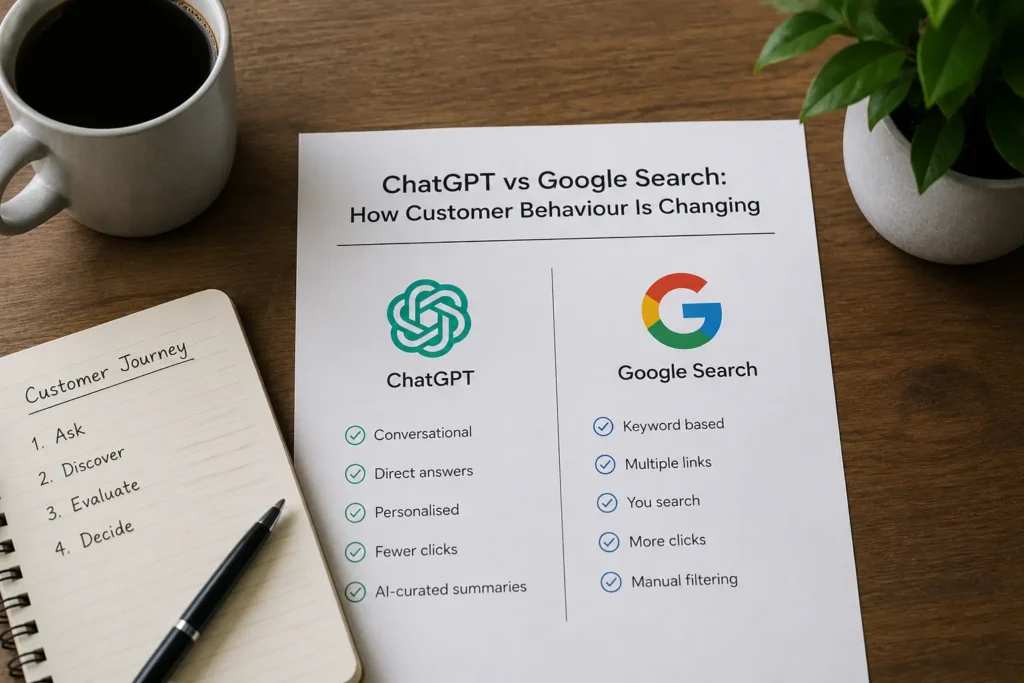
ChatGPT has not replaced Google Search, but it has changed how customers behave. Google still handles around 80% of all digital queries while ChatGPT holds roughly 17% to 20% of search-related traffic, and most people now use both. The real shift is behavioural: customers increasingly ask a question and accept a direct answer rather than scanning a list of links. That moves the goal for businesses from ranking on Google to being the trusted source AI cites, which is why answer engine optimisation (AEO) and generative engine optimisation (GEO) now sit alongside traditional SEO.
The instinctive way to frame this is a heavyweight bout: ChatGPT versus Google, one winner, one loser. It makes a good headline and it misreads the situation entirely.
Google is not losing. Its search volume has grown, not fallen. ChatGPT is not a Google-killer; most of its users still open Google every day. The interesting story is quieter and more consequential than a contest. It is a change in how people behave when they want to know something, and that change reaches every business that depends on being found. This article lays out what the data actually shows, what is really shifting in customer behaviour, and what it means for how you get discovered. For the broader strategic context, our pillar on AI search visibility frames the wider picture.
The scoreboard, read honestly
Start with the numbers, because the popular version is wrong in both directions.
Google still dominates raw query volume. Estimates for 2026 put it at roughly 80% of all digital queries, with ChatGPT at around 17% and other AI platforms making up the remainder. By some measures Google handles hundreds of times more searches per day than ChatGPT’s search-style prompts. Reports of its death are, to borrow a phrase, greatly exaggerated.
But ChatGPT’s rise is real and fast. It reached around 883 million monthly users by early 2026, processes roughly 2 billion queries a day, and holds the lion’s share of the AI assistant market. By session volume it has become the second-largest information discovery platform in the world. Analysis suggests ChatGPT now accounts for around 20% of search-related traffic globally.
Here is the figure that resolves the apparent contradiction: total search usage, search engines and AI assistants combined, has grown roughly 26% globally. Google’s slice of combined information discovery has fallen even as its absolute volume rose. The pie got bigger, and AI took the new slice. Around 95% of AI platform users still use traditional search engines too. People did not switch. They added a tool. Gartner had projected traditional search volume falling about 25% by 2026, and the broader reallocation is tracking close to that.
| Metric | Google Search | ChatGPT |
| Share of digital queries (2026) | ~80% | ~17% |
| Monthly users | Billions | ~883 million |
| Role in the journey | Broad search, verification | Conversational research, recommendations |
| Typical behaviour | Scans links | Asks and accepts an answer |
The real story: from searching to asking
Market share is the wrong lens. The thing that actually changes how businesses get found is the behaviour underneath the numbers.
For twenty years, search meant a particular ritual. Type a few keywords, scan a page of blue links, click two or three, piece together your own answer from what you found. People learned to think in keywords and to do the synthesis themselves.
Conversational AI dissolves that ritual. Instead of “best CRM small business,” people now type “I run a 12-person agency, which CRM should I use and why?” and get a synthesised answer back, often with reasoning, comparisons and recommendations. They ask follow-up questions in plain language. They treat it like a conversation with a knowledgeable colleague rather than a query against a database. Google itself has absorbed this behaviour with AI Overviews, so the shift is happening inside traditional search as well as outside it.
Three behavioural changes matter most for businesses.
People expect an answer, not options. The work of comparing and synthesising has moved from the user to the machine. Whoever the machine draws on to build that answer wins the moment of consideration.
People accept fewer sources. A list of ten links invited choice. A generated answer names a handful of sources, or sometimes none, a phenomenon known as the zero-click search. The funnel of consideration has narrowed dramatically, which raises the stakes of being one of those named sources.
People trust the synthesis. When an AI confidently assembles an answer, many users accept it without cross-checking. That trust is transferred to the businesses the answer recommends, which is a powerful position to occupy and a costly one to be excluded from.
Why this changes how businesses get found
If customers are asking instead of scanning, the marketing objective has to move with them.
The old goal was a ranking: get your page near the top of Google’s results and earn the click. The new goal is to be the source: become the business the answer is built from, whether that answer appears in an AI Overview, a ChatGPT reply or a Perplexity citation. Ranking still matters, because AI Overviews lean heavily on traditional rankings and a strong, authoritative site is the entry ticket to the pool AI draws from. But ranking is now a means rather than the destination.
This is why search optimisation in 2026 is best understood as three layers rather than one. Traditional SEO earns your place in the results and feeds AI Overviews. Answer engine optimisation wins the direct answer in snippets, AI Overviews and voice. Generative engine optimisation gets you cited inside what ChatGPT, Gemini, Claude and Perplexity actually say. They layer, they reinforce each other, and the businesses pulling ahead run them as one programme rather than three competing budgets. We explore how this is reshaping the discipline in our guide to how AI search is changing SEO.
The conversion twist most marketers miss
There is a counterintuitive upside buried in this shift, and it reframes the anxiety about lost clicks.
AI search sends less traffic, but the traffic it sends is better. Because visitors arriving from an AI assistant have already had their question answered and their options narrowed, they show up further down the decision path. Multiple 2025 and 2026 studies found AI-referred visitors converting at several times the rate of traditional organic visitors, with some retail measurements putting ChatGPT-referred conversion at more than double Google organic. AI referral volume is still small relative to total web traffic, but it is growing fast and it punches well above its weight on quality.
The implication is clear. Being cited by AI is not a consolation prize for lost rankings. It is access to a smaller stream of unusually high-intent prospects, which for most businesses is exactly the stream worth fighting for. It is also why so many brands now see website traffic dropping after LLMs while their best enquiries hold steady.
For Australian businesses specifically, this matters more than the global averages suggest. Australia is among the fastest adopters of AI search in the world, and Google AI Overviews appear on a far higher share of searches here than the global rate. That means the behavioural shift, customers asking rather than scanning, is further along in Australian markets than in most. A Sydney professional services firm, a Melbourne retailer or a Brisbane trades business is already fielding fewer clicks from people who got their answer upstream, and competing for the recommendation that decides who those people contact. The local lead is an opportunity for businesses that move now and a liability for those that wait, because the gap between the cited and the invisible widens fastest in the markets adopting AI quickest.
What businesses should do now
You do not need to abandon what works or chase every new platform. A measured sequence beats a panic.
Find out where you stand first. List the ten to fifteen questions a customer asks before choosing a business like yours, in their own words, and put each to ChatGPT, Gemini, Claude and Perplexity. Note where you are named, where competitors appear, and where nobody relevant shows up. Check your analytics for referral traffic from chatgpt.com and perplexity.ai, and watch Google Search Console for impressions rising without matching clicks, the signature of AI Overviews absorbing your traffic.
From that baseline, the priorities order themselves. Lead with clear, direct answers on your most important pages, because AI favours content it can extract cleanly and much of what it cites comes from the opening of a page. Build entity clarity through consistent business details, structured data and internal linking, so AI understands who you are and what you do. Strengthen the authority signals AI verifies, genuine reviews, credentials and third-party mentions. Keep your best content current. And measure visibility across AI platforms, not just Google rankings, because the two no longer move in step. This is the same evolution facing every sector, explored in our look at AI search for Australian service businesses.
What law firms and service businesses should take from this
The behavioural shift hits trust-led industries hardest, and that is where it is most worth watching. When a prospective client asks an AI “who should I hire for a property settlement in Sydney” or “which firm handles workplace injury claims,” the businesses named are the ones AI has come to trust through verifiable credentials, consistent information and genuine reputation. For sectors where the buyer needs to trust before they call, a law firm, an accountant, a clinic, being the cited source is the entire game. This is why we treat AI visibility for sectors like law firms as a credibility-engineering problem rather than a keyword one, and it is closely tied to how law firms get recommended by ChatGPT.
What realistic adaptation looks like
It is worth being candid, because this space attracts inflated promises. AI visibility is a compounding investment, not a switch. Authority, entity recognition and content depth build over months, and the businesses that started early are already harder to displace. Structure and freshness move faster.
What no one can honestly offer is a guaranteed position in AI answers. There is no fixed slot to buy in ChatGPT or AI Overviews, results shift with phrasing and model updates, and cited sources genuinely churn. Anyone promising guaranteed AI rankings is selling a fiction. What proper work does, done well, is steadily raise the probability that your business is the one trusted enough to be named.
Why Uprise Digital leads on AI visibility in Australia
Plenty of agencies added “AI” to their service list this past year. Far fewer rebuilt their approach around how customers now behave and how AI selects sources. That is the work Uprise Digital does.
We treat AI visibility as a credibility-engineering problem, not a keyword one. Engagements begin with an AI visibility audit across Google AI Overviews, ChatGPT, Perplexity, Gemini and Claude, so you know exactly where you appear, where competitors are cited instead, and what the gap is costing you. From there we build the entity clarity, structured content, authority signals and ongoing measurement that move the needle, integrated across AI SEO, AEO and GEO rather than bolted on. And we report honestly, on AI citations as well as Google rankings, and we are always plain about what AI visibility can and cannot do.
Where this leaves Australian businesses
The contest framing misses the point. Google is not going away, and ChatGPT did not kill it. What changed is how customers behave: they ask instead of scan, they accept answers instead of browsing options, and they trust the source the answer names. That is a quieter shift than a knockout, and a more important one.
The businesses being cited inside AI answers are quietly compounding an advantage while everyone else argues about who is winning. If you would rather not guess, the sensible first move is an AI visibility audit: a clear baseline of where you are named, where you are absent, and what to fix first. That is the work Uprise Digital does for Australian businesses adapting to conversational discovery. The brands customers find in 2026 are the ones doing this work in 2026, not the ones still waiting to see who wins.
Ready to be the answer instead of the afterthought? Uprise Digital builds AI SEO programmes that turn AI visibility into real pipeline. See how we get you cited with generative engine optimisation, or use the wider toolkit in our overview of AI tools for digital marketing.
FAQ
Is ChatGPT replacing Google Search?
No. Google still handles around 80% of digital queries and its volume has grown, while about 95% of AI users also use traditional search. ChatGPT is a fast-growing parallel channel, not a replacement, and most people now use both.
How are customers using ChatGPT differently from Google?
They ask full, conversational questions and accept a synthesised answer rather than scanning links and piecing together their own. The work of comparing options has shifted from the user to the AI.
Why do people trust AI-generated answers?
Because the answer arrives confident, synthesised and tailored to the question. Many users accept it without cross-checking, which transfers trust to the businesses the answer recommends.
Does AI search mean less traffic for my business?
Often less volume, but higher quality. AI-referred visitors arrive pre-informed and, in multiple studies, convert at several times the rate of traditional organic visitors, so the smaller stream is unusually valuable.
What should businesses do to stay visible?
Build on solid SEO with AEO and GEO: lead with clear answers, build entity clarity and structured data, strengthen authority signals like reviews and credentials, keep content fresh, and measure visibility across AI platforms, not just Google.
Can ChatGPT recommend my business?
Yes, if it can find, parse and trust you. That means strong authority, consistent information across the web, clear structure, and being indexed in Bing, which ChatGPT’s search draws on.
What is the future of search in Australia?
A diversified, answer-led landscape where customers move between Google and AI assistants in a single research session. Success will be measured by citations and brand visibility across platforms, not by rankings alone.
Key takeaways
- Google has not shrunk; total search grew, and AI took the new slice. ChatGPT is now the second-largest information discovery platform by session volume.
- Around 95% of AI users still use traditional search engines, so this is a both-and shift in behaviour, not a clean switch.
- The behavioural change matters more than the market share: people now ask and accept answers rather than browsing links.
- AI-referred visitors arrive pre-informed and convert at a far higher rate than traditional organic visitors in many studies.
- Visibility now means being cited across Google, ChatGPT, Gemini and Perplexity, which requires building on SEO with AEO and GEO.
Resources
These external sources inform the data and claims in this article, and are useful authority references on the shift to AI search:
- Google, Generative AI in Search guidance: official documentation on AI Overviews and AI features in Search.
- OpenAI: primary source on ChatGPT search and usage.
- Gartner Newsroom: forecast that traditional search volume will fall around 25% by 2026.
- Pew Research Center: research on search behaviour and zero-click sessions when AI answers appear.
- SparkToro: zero-click search analysis with Datos.
- Search Engine Land: ongoing reporting on AI search behaviour and SERP changes.
- Wikipedia, Zero-click search: background on the zero-click phenomenon.