
Local business AEO in Australia is the work of making your business the one an AI assistant names when someone asks ChatGPT, Gemini, Claude or Perplexity for a recommendation in your city. It comes down to four things: an accurate and detailed Google Business Profile, consistent listings across trusted directories, a steady flow of specific customer reviews, and website pages that answer buying questions in plain language. Get those four right and AI assistants have everything they need to recommend you.
This guide is the practical version. We cover where AI tools pull local business data from, a step-by-step checklist you can work through in a fortnight, how to test your own visibility tonight, and what to measure. If you want the bigger picture on how buying behaviour is shifting, read our breakdown of ChatGPT vs Google search customer behaviour first.
What is AEO for a local business?
Answer engine optimisation (AEO) is the practice of structuring your business information and content so AI assistants and answer engines can quote it directly, instead of just ranking your website in a list of links. For a local business the target question is nearly always some version of “who is the best X in Y city” or “who can fix Z near me”. Classic SEO gets you into the results page. AEO gets you into the answer itself, whether that answer appears in ChatGPT, Google’s AI Overviews, Perplexity or a voice assistant.
AEO does not replace local SEO. It sits on top of it and borrows most of its inputs: the majority of the work below also improves your Google Maps and organic rankings. We explain the overlap in more depth in our guide to AI search visibility in Australia.
Where do AI assistants get local business data?
AI assistants do not have a private database of Australian businesses. They assemble answers from a handful of public sources, and every one of them is something you can influence. If your business is invisible in AI answers, the gap is almost always in one of these five places.
| Data source | What the AI takes from it | What you control |
|---|---|---|
| Google Business Profile | Name, category, services, hours, service area, photos, Q&A | Complete every field, keep categories accurate, post updates |
| Reviews (Google, industry sites) | Volume, recency, and the specific services and suburbs reviewers mention | Ask every happy customer, prompt them to name the job and location |
| Directories and citations | Confirmation that your name, address and phone details are consistent | Fix mismatched listings on Yellow Pages, Hipages, TrueLocal, industry bodies |
| Your website content | Direct answers, pricing guidance, service and suburb pages, FAQs | Publish question-led pages with clear, quotable answers |
| Reddit, forums and local media | Unpaid third-party mentions and recommendations | Earn mentions through genuine service, local PR and community presence |
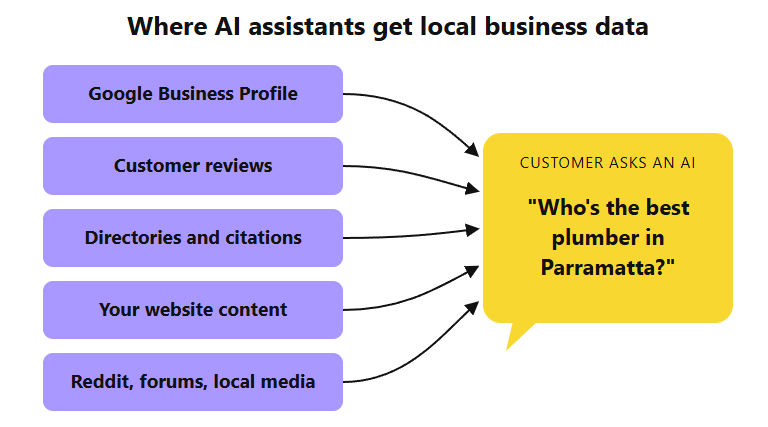
Two notes. ChatGPT and Perplexity run live web searches for local queries, so what they find in real time matters as much as their training data. And Reddit threads like “best mechanic in Brisbane” get quoted constantly because they read as genuine recommendations. You cannot fake that, but you can earn it.
How do you do local business AEO in Australia? A step-by-step checklist
Work through these seven steps in order. Most local businesses can finish the first five inside two weeks.
1. Complete your Google Business Profile properly
Fill every field: primary and secondary categories, every service you offer with a description, service areas, hours, photos of real jobs, and answers in the Q&A section. Google’s own Business Profile guidelines spell out what a complete profile looks like. This is the single highest-weight source for local AI answers.
2. Fix your citations
Search your business name and phone number. Every listing that shows an old address, a former trading name or a dead number is a contradiction that makes AI tools less confident about recommending you. Correct the big ones first: Yellow Pages, TrueLocal, Hipages or your industry equivalent, and your professional association listing.
3. Build review volume with specifics
Ask every satisfied customer for a review, and prompt them to mention the service and the suburb. “Great work” tells an AI nothing. “Replaced our switchboard in Joondalup the same week we called” tells it exactly which queries you deserve to win.
4. Publish question-led service pages
For each core service, write a page that opens with a direct answer, covers cost ranges honestly, and ends with an FAQ. Use the real questions customers ask you on the phone as your H2s. Answer each one in two or three sentences before you expand.
5. Add LocalBusiness and FAQ schema
Structured data confirms your details in a format machines parse without guessing. Follow the Google Search Central local business markup guide and use the schema.org LocalBusiness type that matches your category, plus FAQPage markup on your question content.
6. Earn third-party mentions
Sponsor the local footy club and get the writeup, pitch a comment to a local news story, answer questions helpfully in community Facebook groups and subreddits. One genuine unpaid mention outweighs a page of self-promotion because AI tools treat it as independent evidence.
7. Localise for every city you serve
AI answers are city-specific, so your signals need to be too. A Sydney electrician and a Perth electrician are competing in completely different answer sets. We have broken down the local dynamics for each major market: AEO in Sydney, AEO in Melbourne, AEO in Brisbane, AEO in Perth, AEO in Adelaide and AEO on the Gold Coast.
How do you test your own AI visibility?
You can audit yourself tonight for free. Open ChatGPT, Perplexity and Gemini and ask each one your money questions, the exact things a customer would type the week before they buy:
- “Who is the best [your service] in [your city]?”
- “I need a [your service] in [your suburb], who do you recommend?”
- “How much does [your core job] cost in [your city]?”
- “[Your business name] reviews”
Record three things for each answer: whether you are named, who is named instead, and which sources the tool cites. Perplexity shows its citations openly, making it the best diagnostic of the three. If a competitor keeps appearing, check the cited sources and you will usually find a directory, review profile or Reddit thread doing the work for them.
Repeat the same questions monthly in a fresh chat, since answers vary between sessions.
What should you measure?
AI answers have no rank tracker, but the results still show up in numbers you already have. Track five:
- Mention rate: the share of your monthly test questions where an AI names your business. This is your headline AEO metric.
- AI referral traffic: sessions from chatgpt.com, perplexity.ai and gemini.google.com in your GA4 referral report.
- Branded search volume: people who hear your name from an AI often verify you on Google next, so watch branded impressions in Search Console.
- Direct GBP actions: calls and direction requests from your Business Profile, which capture people acting on a recommendation without visiting your site.
- “How did you hear about us”: add “an AI tool like ChatGPT” as an option on your enquiry form. Crude, but it catches what analytics miss.
Expect movement in one to three months, not days, with profile and citation fixes flowing through fastest. For why this channel is worth measuring at all, see why businesses need AI visibility beyond Google rankings.
Frequently asked questions
Is AEO different from local SEO?
They overlap heavily but aim at different outcomes. Local SEO gets you ranked in Google Maps and organic results. AEO gets you named inside AI-generated answers. Most inputs are shared, including your Google Business Profile, reviews and citations. AEO adds question-led content, schema markup and third-party mentions that AI tools treat as evidence.
How long does local business AEO take to work?
Fixes to your Google Business Profile and citations can influence ChatGPT and Perplexity answers within weeks because those tools check live sources. Reputation signals such as review volume and unpaid mentions build over one to three months. Treat it as an ongoing practice with monthly testing rather than a one-off project.
Do I need to rank first on Google to appear in AI answers?
No. AI assistants weigh review quality, consistent business data and third-party mentions alongside rankings, so businesses outside the top organic spots get recommended regularly. Strong rankings help because AI tools read search results, but a complete profile with specific reviews can beat a higher-ranked competitor with thin ones.
Which AI assistants matter most for Australian local businesses?
Start with ChatGPT, Google’s Gemini and AI Overviews, and Perplexity. ChatGPT has the largest consumer reach, Google’s AI results sit directly inside the search experience Australians already use, and Perplexity shows citations, which makes it the most useful for auditing. Optimising the shared data sources improves all of them at once.
Can I do local business AEO myself?
Yes, most of it. Completing your Google Business Profile, fixing citations, asking for specific reviews and testing your visibility monthly need time rather than technical skill. Businesses usually bring in an agency for schema markup, question-led content at scale and earning media mentions, or when they serve multiple cities.
Want AI assistants recommending your business by name?
We run the full process for Australian local businesses: profile and citation cleanup, question-led content, schema, mention building and monthly AI visibility testing. See what is included on our answer engine optimisation service page, or skip ahead and book a free strategy session. We will run your money questions through ChatGPT, Perplexity and Gemini live on the call and show you exactly where you stand.