
Google Ads for builders in Australia works when campaigns are built around job type, service area and lead quality rather than clicks. Because a single new build or major renovation is worth six or seven figures, one signed contract can pay for many months of ad spend. The builders who win run separate campaigns for new builds, extensions and renovations, qualify budgets before the phone rings, and send traffic to portfolio pages that prove their work.
This guide covers the full playbook for custom home builders, renovation builders and commercial builders: campaign structure, geo targeting, lead qualification, landing pages, seasonality, and what a realistic cost per qualified lead looks like. It is based on the campaigns we run for building companies through our digital marketing service for builders.
Does Google Ads Actually Work for Builders?
Yes, and the maths works harder for builders than for almost any other trade. An electrician needs a steady stream of small jobs, so their campaigns chase volume at a low cost per lead. We covered that model in our guide to Google Ads for electricians. A builder is playing a different game. A custom home commonly runs well into the hundreds of thousands of dollars, a major extension or renovation into six figures, and commercial projects higher again.
That changes two things. First, you do not need many leads. Ten genuinely qualified enquiries a month is a strong result for most custom builders, because you only have capacity for a handful of projects at a time. Second, you can afford to pay far more per lead than a plumber or sparkie ever could. A lead that costs $400 sounds expensive until it becomes a $600,000 contract.
The catch is the sales cycle. Homeowners rarely sign a building contract off the back of one search. The journey from “knock down rebuild cost” to a signed contract often takes six months or more, with finance, design and council approvals in between. So do not judge a builder campaign on week two. Judge it on cost per qualified lead in the first quarter, and cost per signed contract over six to twelve months.
How Should Builders Structure Google Ads Campaigns?
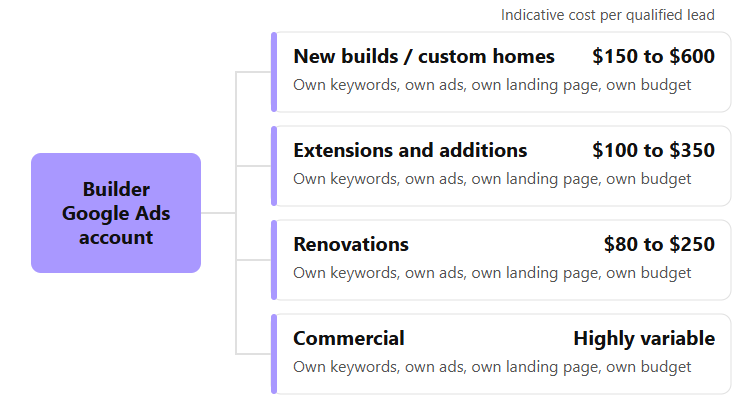
Structure the account by job type, not as one catch-all campaign. Someone searching “custom home builders” has a completely different budget, timeline and mindset to someone searching “bathroom renovation cost”. If they share a campaign, they share a budget, the same ads and the same landing page, and Google cannot optimise for the jobs you actually want.
For most residential builders, three campaigns cover it: new builds, extensions and additions, and renovations. Commercial builders should run commercial work in its own campaign with its own language (design and construct, fit-outs, industrial sheds), because commercial searchers use different terms and respond to different proof.
| Campaign | Example keywords | Job value profile | Indicative cost per qualified lead* |
|---|---|---|---|
| New builds / custom homes | custom home builders [city], knock down rebuild [suburb], new home builders near me | Highest value, longest sales cycle | $150 to $600 |
| Extensions and additions | home extension builders [city], second storey addition cost, house extensions [suburb] | Mid to high value, medium cycle | $100 to $350 |
| Renovations | renovation builders [city], full home renovation, kitchen and bathroom renovation builder | Mid value, shorter cycle, higher enquiry volume | $80 to $250 |
| Commercial | commercial builders [city], design and construct builders, office fitout company | Highest variance, often tender or relationship driven | Highly variable |
*Planning ranges based on our experience with Australian builder campaigns, not guarantees. Your numbers depend on city, competition, offer and landing page quality.
Start with phrase and exact match keywords, then build an aggressive negative keyword list from day one. Builders bleed budget on searches for “builder jobs”, “DIY”, “cheap”, “kit homes”, “apprenticeship” and “salary”. Review the search terms report weekly for the first two months and cut anything that is not a genuine project enquiry. This is where most self-managed accounts fail, and it is one of the seven Google Ads mistakes we see most often.
How Do You Geo Target Around Your Service Areas?
Target where you are willing to build, not where Google defaults to. A radius around your office is rarely right for a builder. You might happily take a knock down rebuild 40 minutes away but have no interest in a small renovation at the same distance. Set location targeting per campaign: a wide area for new builds where the job value justifies travel, and a tighter map for renovations.
Two settings matter more than most builders realise. In Google Ads location settings, choose “presence” so ads show to people physically in your service area, not people elsewhere who are merely interested in it. Then use location exclusions to carve out suburbs you will not service, even inside your targeted region.
Go a step further and bid by suburb. Established suburbs with ageing housing stock are where knock down rebuild and extension demand lives. Growth corridors suit volume new builds. If your best projects come from a dozen postcodes, increase bids there and let the rest of the map run at base rates. Review the “locations” report monthly and shift budget toward the suburbs producing signed contracts, not just clicks.
How Do You Qualify Leads Before the Phone Rings?
Qualify in the ad, then again in the form. Every unqualified enquiry costs you twice: once for the click and once for the time spent on a phone call that goes nowhere.
In the ad copy, state your positioning plainly. “Custom homes from $500k” or “Architect-designed extensions” repels tyre kickers before they click, which is exactly what you want when clicks cost real money. Say what you do not do as well: if you do not take repairs, maintenance or insurance work, the ad should make that obvious.
On the form, ask three qualifying questions: project budget (as a dropdown with ranges), timeframe, and land or property status (own the land, buying, knock down rebuild). A multi-step form that starts with the easy question and ends with contact details will filter out low-intent enquiries without hurting genuine ones. Serious clients planning a six-figure project expect to answer these questions. Then respond fast. A builder who calls back within the hour beats a cheaper competitor who calls back on Friday.
This qualification mindset applies across every channel you run, and we cover the broader system in our tradie marketing guide.
What Should a Builder Landing Page Look Like?
Portfolio first. A homeowner about to commit hundreds of thousands of dollars wants proof you have built what they want to build, in an area like theirs. Send each campaign to its own page: new build traffic to a page full of completed homes, renovation traffic to before-and-after projects. Never send paid traffic to your homepage.
The page needs recent projects with suburb names, your builder licence number, client testimonials, clear service area, and an enquiry form with the budget qualifiers above. Add a simple “how we work” section covering your process from first meeting to handover, because reducing perceived risk is most of the sale at this price point. Our list of 8 must-have website features for Australian tradies covers the fundamentals that apply here too.
One legal note: any claims about pricing, inclusions or timeframes on your ads and landing pages must hold up under Australian Consumer Law. The ACCC advertising and selling guide is worth a read before you publish a “fixed price” promise.
When Should Builders Spend More, and When Should They Pull Back?
Builder demand is seasonal, but not in the way most people assume. Enquiries tend to lift in the new year when families commit to plans they discussed over summer, and again in spring. December usually goes quiet for residential decisions, while commercial work often moves around end of financial year budgets. Your own enquiry data will show the pattern within a season or two, which is a good reason to get conversion tracking right early.
Because the sales cycle is long, think one season ahead. The quiet months are when next quarter’s contracts start researching, so a builder who pauses ads in winter is handing spring projects to competitors. Adjust budgets up and down rather than switching campaigns off, since pausing throws away the conversion data Google’s bidding relies on and you restart from a standing position.
What Does Google Ads for Builders in Australia Cost Per Qualified Lead?
Expect clicks for builder keywords to cost somewhere between roughly $3 and $25, with competitive metro terms like “custom home builders sydney” at the top of that range and long-tail renovation terms lower. Published figures from Australian agencies running construction campaigns sit inside that same band, which matches what we see in client accounts.
Cost per qualified lead is the number that matters, and “qualified” means in your service area, with a realistic budget and timeframe. As planning ranges: renovations typically land around $80 to $250 per qualified lead, extensions $100 to $350, and custom or new builds $150 to $600. Commercial is too variable to generalise.
Now run the contract maths. If one in ten qualified leads becomes a contract and your average job is $400,000, then a $300 qualified lead means about $3,000 in ad spend per signed job. Even at half that close rate, the acquisition cost is a fraction of one per cent of contract value. This is why builders with long sales cycles and high job values can outspend and outlast every other advertiser on the results page, provided lead quality stays high.
None of this works without measurement. Track form submissions and calls as conversions, and feed contract outcomes back into the account so bidding optimises toward the leads that sign, not the leads that are cheapest. Our GA4 conversion tracking guide walks through the setup, and our Google Ads management service handles the whole system for you.
FAQs About Google Ads for Builders
Is $20 a day enough for a builder to run Google Ads?
Usually not in metro markets. At typical builder click costs, $20 buys a handful of clicks a day, which is too little data for Google to optimise against and too few enquiries to judge results. Most builders need $1,500 to $4,000 per month to run one job-type campaign properly. Regional builders with cheaper clicks can start lower.
How long before Google Ads produces a signed building contract?
Enquiries usually start within days of launch, but building contracts follow the sales cycle. Expect the first quarter to be about tuning keywords, negatives and lead quality, with contracts flowing from months three to nine as early enquiries move through design, finance and approvals. Judge the campaign on qualified leads early and on contracts over six to twelve months.
Do Google Ads work for renovation builders as well as new home builders?
Yes, and often faster. Renovation searches carry shorter decision cycles and higher volume than new build searches, so renovation campaigns typically produce more enquiries at a lower cost per lead. The trade-off is smaller job values and more unqualified enquiries, which makes budget qualifiers in your ads and forms even more important for renovation campaigns.
Should builders bid on competitor brand names?
It is allowed as long as your ad does not misleadingly imply you are that competitor, but it is rarely the best first move. Competitor clicks convert poorly for builders because buyers researching a specific builder are usually deep in that builder’s process. Spend the budget on high-intent job-type keywords first, then test competitor terms once those are profitable.
Can a builder run Google Ads themselves?
Yes, if someone in the business owns it weekly: search terms reviews, negative keywords, bid changes and landing page tests. Where self-managed accounts fail is set-and-forget, broad match keywords and no conversion tracking, which quietly burns thousands. If nobody has a few hours a week for it, professional management usually pays for itself in reduced wasted spend.
Win More Building Jobs From Google
Google Ads rewards builders who treat it as a lead engine: structured by job type, targeted to the right suburbs, qualified before the phone rings, and measured through to signed contracts. Get those pieces right and one platform can keep your pipeline full for years.
If you would rather have specialists build it, we run Google Ads for custom, renovation and commercial builders across Australia. Book a free strategy session and we will map out your campaign structure, budget and realistic lead targets before you spend a dollar.