

Law firm website design in Australia comes down to one job: convincing a stressed person, within a few seconds, that your firm handles their exact problem, then making it effortless to enquire. That means a headline naming your practice area and location, visible credentials and reviews, a tap-to-call phone number, and pages that load fast on mobile. Everything else, the animations, the awards carousel, the stock photos of gavels, is secondary. This guide covers what actually converts visitors into clients, including a homepage checklist you can run against your current site today.
What Should a Potential Client See in the First 5 Seconds?
People looking for a lawyer are anxious, time-poor and comparing several firms in open tabs. They scan for three answers: does this firm handle my problem, can I trust them, and how do I contact them right now.
Above the fold, before any scrolling, your homepage needs to answer all three:
- What you do and where. “Family Lawyers in Parramatta” beats “Excellence. Integrity. Results.” every time. Vague taglines make visitors work out whether they are in the right place, and most will not.
- Why they should trust you. A Google review rating, years in practice, or an accreditation badge. One or two signals, not a wall of logos.
- How to make contact. A phone number in the top right that dials on tap, plus one clear button such as “Book a Free Consultation”.
A simple test: show your homepage to someone outside the firm for five seconds, then ask what the firm does, where it operates and how they would get in touch. If they cannot answer, the design is costing you enquiries. The same above-the-fold logic applies to campaign pages, which we break down in our guide to the 11 landing page elements that actually lift conversions.
Law Firm Homepage Checklist: The Elements That Convert
Run your current homepage against this table. Ticking every row turns more of your existing traffic into enquiries, which is cheaper than buying more traffic. We cover the maths of that trade-off in our post on website conversion rates.
| Element | Where it sits | Why it matters |
|---|---|---|
| Headline naming practice area and location | Top of hero section | Confirms the visitor is in the right place instantly |
| Tap-to-call phone number | Header, visible on every page | Phone calls are the highest-intent legal enquiry channel |
| One primary CTA button | Hero, repeated down the page | A single clear action outperforms four competing buttons |
| Google review rating with count | Hero or directly below it | Third-party proof carries more weight than your own claims |
| Accreditation or law society membership | Near the reviews | Signals the firm is legitimate and regulated |
| Practice area tiles with links | First scroll | Routes visitors to the specific page that matches their problem |
| Real photos of your lawyers | Mid-page | People hire people; stock photos read as evasive |
| Response-time promise | Beside the enquiry form | “We reply within one business hour” reduces hesitation |
| Short enquiry form (3 to 4 fields) | Bottom of page and contact page | Every extra field lowers completion |
| Office locations and service area | Footer | Confirms local relevance for clients and for search engines |
How Should Practice Area Pages Be Structured?
Most conversions happen on practice area pages, because that is where someone with a specific problem lands from Google or an AI assistant. Each major service needs its own page, one page per problem, not one “Our Services” page listing everything.
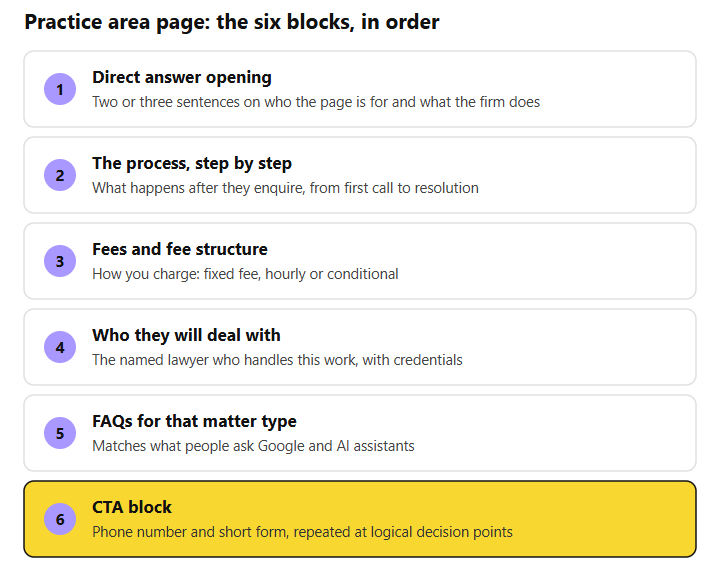
A practice area page that converts follows a consistent structure:
- A direct answer opening. Two or three sentences stating who the page is for and what the firm does about it.
- The process, step by step. What happens after they enquire, from first call to resolution. Uncertainty is the biggest barrier in legal services.
- Fees and fee structure. You do not need exact figures, but explain how you charge: fixed fee, hourly, or conditional. Silence on cost drives people to firms that address it.
- Who they will deal with. Name and photograph the lawyer who handles this work, with credentials.
- FAQs specific to that matter type. These match what people ask Google and AI assistants.
- A CTA block. Phone number and short form, repeated at logical decision points, not just the bottom.
Treat each practice area page as a landing page with one job, and apply the same discipline we describe in our landing page optimisation guide: one audience, one message, one action.
Which Trust Elements Convert Without Breaching Advertising Rules?
Legal services are a trust purchase, but law firm marketing in Australia is regulated, so build trust with elements you can defend.
Credentials. Only claim “Accredited Specialist” if the lawyer actually holds accreditation under a scheme such as the Law Society of NSW specialist accreditation program or its state equivalents. Years of experience, court admissions and professional memberships are safe, verifiable and persuasive.
Results. Past outcomes are powerful but risky. Never imply a guaranteed result, and remember that all marketing claims sit under the misleading and deceptive conduct provisions of the Australian Consumer Law, which the ACCC actively enforces. Personal injury advertising is further restricted by state rules, and Queensland’s restrictions are especially tight. If you practise in personal injury, have your published case results and “no win no fee” wording reviewed against the rules in each state you advertise in before the site goes live.
Reviews. Genuine Google reviews, embedded and updated, are the strongest conversion asset most firms have. Never fabricate, incentivise selectively or edit reviews; the ACCC treats fake reviews as misleading conduct. Ask every satisfied client for a review as a standard step at file closure.
Photography. Real photos of your team and office consistently outperform stock imagery. Clients are choosing a person to trust with a serious problem, and stock photos read as evasive. This is one of the most common fixes we make on law firm marketing engagements.
Forms, Phone or Live Chat: What Reduces Enquiry Friction?
Offer at least two contact channels, because different clients have different comfort levels. But each channel has rules.
Phone is the highest-intent channel in legal. Make the number tap-to-call on mobile, and make sure it is answered. A conversion-optimised website feeding an unanswered phone is wasted money. If reception cannot cover peak times, use an answering service rather than voicemail.
Forms should ask for name, phone, email and a one-line description of the issue. Nothing else. Do not ask visitors to pick from a 15-item dropdown or write a full history. State your response time next to the submit button and honour it.
Live chat only helps if someone is actually behind it, or if an after-hours bot captures contact details cleanly. A silent chat widget damages trust more than no chat at all.
Whatever mix you choose, track it. Record call clicks, form submissions and chat starts as conversions so you know which pages produce clients, not just visits.
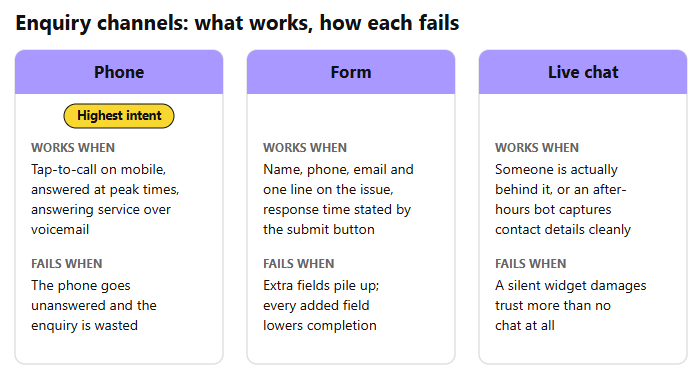
Every enquiry channel works, and every one fails when it is left unattended.
Why Do Mobile Speed and Accessibility Decide Conversions?
A large share of legal searches happen on a phone, often outside business hours, at the moment the problem becomes urgent. If your site takes six seconds to render on 4G, visitors are gone before your headline appears. Google’s guidance sets a clear benchmark: Largest Contentful Paint within 2.5 seconds, as documented in Google Search Central’s Core Web Vitals documentation. The usual offenders on law firm sites are autoplay hero videos, uncompressed images and page builders stacked with plugins.
Accessibility matters for the same commercial reason. Many legal clients are older, stressed, or using a phone one-handed in poor light. Sufficient colour contrast, readable font sizes, buttons large enough to tap, keyboard navigation and descriptive alt text are not box-ticking. They expand the pool of people who can actually use your site to hire you.
What SEO and AEO Foundations Must Your Design Not Break?
A redesign is where law firms most often destroy their own rankings. Design and search visibility are not separate projects; the design must preserve the foundations that make you findable.
- Keep your URLs, or redirect them. Every page that changes address needs a 301 redirect to its new home, or you forfeit the authority those pages earned.
- Keep real, crawlable text. Text baked into images or rendered only through heavy JavaScript is invisible to many crawlers and AI systems.
- Keep one H1 per page and a logical heading structure. Question-form headings help you appear in featured snippets and AI answers.
- Keep structured data. LegalService, LocalBusiness and FAQPage schema help search engines and AI assistants understand who you are, where you practise and what you answer.
- Keep your name, address and phone details consistent across the site, your Google Business Profile and directories.
These same foundations drive answer engine optimisation. ChatGPT, Claude, Gemini and Perplexity recommend firms whose sites state plainly who they help and where, in text those systems can retrieve and quote. We explain the mechanics in our posts on how law firms get recommended by ChatGPT and what actually matters in AI SEO for lawyers. If you are briefing a designer or agency, put this list in the contract. Our web design team builds these requirements in from the wireframe stage because retrofitting them after launch always costs more.
Frequently Asked Questions
How much does law firm website design cost in Australia?
Custom law firm websites from Australian agencies ranking on page one for this keyword are quoted between $8,000 and $40,000, depending on page count, custom design and content requirements. Template-based builds cost less but tend to look interchangeable with competitor sites. Judge the price against enquiry value: one retained family law client often covers a large share of the build.
How long does a law firm website take to build?
Agencies we reviewed for this article quote around 12 to 15 weeks for a fully custom build, covering strategy, wireframes, design, content and development. Smaller sites move faster. The most common delay is the firm itself supplying content and photography late, so lock those in before development starts.
How many pages does a law firm website need?
At minimum: a homepage, one page per practice area, individual lawyer profile pages, an about page and a contact page. A firm with five practice areas and four lawyers needs roughly 12 to 15 pages. Add blog or FAQ content over time to capture question-based searches and AI citations.
Can Australian law firms publish past case results on their website?
Often yes, but with care. Results must not be misleading or imply guaranteed outcomes, and personal injury advertising faces additional state restrictions, particularly in Queensland. Present results as factual summaries with context, avoid superlatives you cannot substantiate, and have compliance-sensitive pages reviewed before publishing.
Do law firms still need a good website if clients use ChatGPT to find lawyers?
Yes, more than before. AI assistants build their recommendations from crawlable web content, so a clear, fast, well-structured website is exactly what gets a firm cited. And whether the visitor arrives from Google or from an AI answer, the website still has to convert them into an enquiry.
Get a Website That Wins Clients, Not Just Compliments
A law firm website is a business asset with one measurable output: qualified enquiries. If your current site looks fine but the phone is quiet, the problem is almost always conversion design, not traffic. We build and fix websites for Australian law firms with the checklist above as the baseline, then connect them to SEO and AI search visibility.
Book a free strategy session and we will review your current website against every element in this guide, no obligation.