
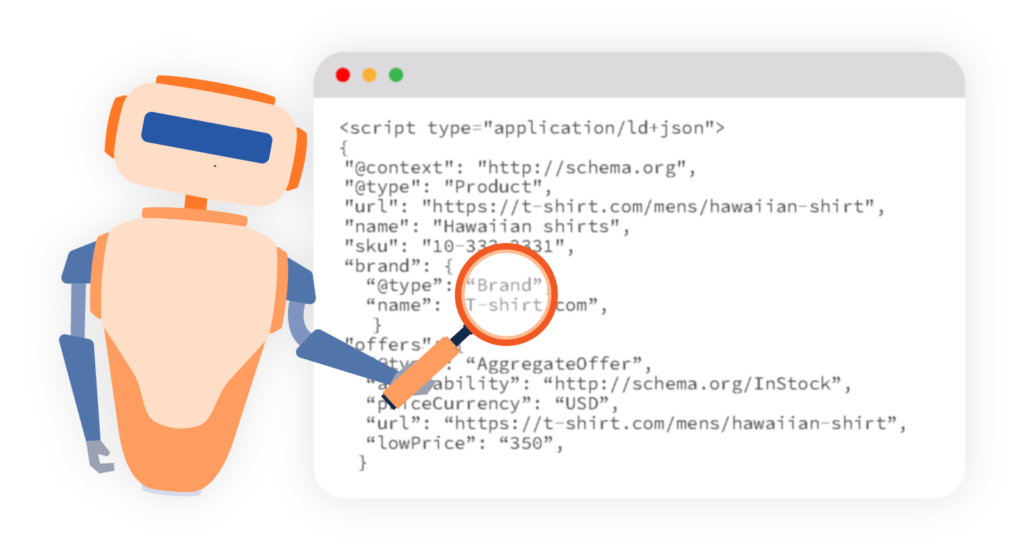
Schema markup for AEO is structured data, usually JSON-LD, that you add to your pages so answer engines like ChatGPT, Google AI Overviews, Perplexity and Gemini can identify exactly what your business is, what each page covers and who wrote it.
It will not force an AI to cite you, but it removes the guesswork that stops machines from parsing your content correctly. For most Australian businesses, the priority types are Organization, LocalBusiness, FAQPage, Article and Service, added through a plugin like Rank Math and validated with Google’s Rich Results Test.
This guide walks through the exact types to implement, working JSON-LD examples you can adapt, where to paste them in WordPress, and how to check they work.
What does schema markup actually do for answer engines?
Schema markup is a vocabulary maintained at schema.org that labels the meaning of your content in a format machines read natively. A human can tell that “Open 7am to 5pm, Mon to Fri” is your trading hours. A crawler is guessing. Schema states it outright: this is an openingHoursSpecification, this is the telephone, this is the areaServed.
That disambiguation matters more in AI search than it did in classic SEO. Answer engines build responses by retrieving passages and connecting them to entities: real businesses, real people, real services. When your Organization schema, your Google Business Profile and your website content all describe the same entity consistently, retrieval systems can attribute your content with confidence. When they conflict or are missing, you are harder to cite. We cover the broader shift in our guide to how AI search is changing SEO in Australia.
Is schema markup a ranking factor for AI answers?
No single markup type guarantees an AI citation, and anyone selling schema as a magic switch is overpromising. Google has said for years that structured data helps understanding rather than directly boosting rank, and the same honest framing applies to answer engines. Schema is one signal among many. Content quality, entity consistency, crawlability and third-party mentions all carry weight.
The evidence still favours doing it. AirOps’ 2026 State of AI Search research found pages that pair clear heading structure with schema markup earned around 2.8 times higher AI citation rates than poorly structured pages, and that FAQ schema appeared on only about 10.5 per cent of AI-cited pages, so the field is far from saturated. The same research found pages using three or more schema types were roughly 13 per cent more likely to be cited. Treat schema as cheap, durable infrastructure: a few hours of work that makes every other AI SEO effort easier to attribute to you.
Which schema types matter most for AEO?
Not all 800-plus schema.org types are worth your time. These eight cover almost every Australian service business, ranked by where we implement them first.
| Priority | Schema type | What it tells answer engines | Where to use it |
|---|---|---|---|
| 1 | Organization | Who your business is: name, logo, contact details, social profiles | Site-wide, usually the homepage |
| 2 | LocalBusiness | Physical location, hours, service area, phone | Homepage or contact page for businesses serving a local area |
| 3 | FAQPage | Question and answer pairs that mirror how people query AI assistants | Pages with a genuine visible FAQ section |
| 4 | Article | Headline, author, publisher and dates for editorial content | Every blog post |
| 5 | Service | What you offer, who provides it and the area served | Each service page |
| 6 | Person | Author identity, credentials and profile links (E-E-A-T signals) | Author bios, nested in Article schema |
| 7 | Product | Price, availability and ratings | Ecommerce and product review pages only |
| 8 | BreadcrumbList | Where a page sits in your site hierarchy | Site-wide, usually handled by your SEO plugin |
Start at the top and work down. A solar installer with Organization, LocalBusiness, Service and FAQPage markup is better positioned than one with twenty half-configured types.
How to implement schema markup for AEO, step by step
Step 1: Audit what you already have
Run your homepage, one service page and one blog post through the Schema.org validator. Most WordPress themes and SEO plugins already output something. Note what exists, what is wrong (old business names, missing logos, placeholder text a developer never replaced) and what is missing entirely. Fixing conflicting markup comes before adding new markup, because two scripts describing your business differently is worse than one.
Step 2: Write your Organization and LocalBusiness markup
This is your entity anchor. Use JSON-LD, which Google recommends and which keeps structured data out of your visible HTML. Here is a working example for a fictional Brisbane solar installer. The code below is displayed for reading, so copy it into your own script block and swap in your real details:
<script type="application/ld+json">
{
  "@context": "https://schema.org",
  "@type": "Electrician",
  "name": "Northside Solar Co",
  "url": "https://www.northsidesolar.com.au/",
  "logo": "https://www.northsidesolar.com.au/logo.png",
  "telephone": "+61 7 3000 0000",
  "address": {
    "@type": "PostalAddress",
    "streetAddress": "12 Sample St",
    "addressLocality": "Chermside",
    "addressRegion": "QLD",
    "postalCode": "4032",
    "addressCountry": "AU"
  },
  "areaServed": "Brisbane",
  "openingHoursSpecification": {
    "@type": "OpeningHoursSpecification",
    "dayOfWeek": ["Monday", "Tuesday", "Wednesday", "Thursday", "Friday"],
    "opens": "07:00",
    "closes": "17:00"
  },
  "sameAs": [
    "https://www.facebook.com/northsidesolar",
    "https://www.linkedin.com/company/northsidesolar"
  ]
}
</script>
Note the specific type: schema.org has no solar installer type, so Electrician is the closest fit. It is a subtype of LocalBusiness, which inherits everything from Organization. Always pick the most specific type that fits. The sameAs array is underrated for AEO because it links your website entity to the profiles answer engines already know about.
The AEO schema stack: Organization and LocalBusiness at the base, Service and Article in the middle, FAQPage and Person at the top.
Step 3: Add FAQPage markup to pages with real FAQs
FAQ markup mirrors the question-and-answer format answer engines work in. The rule is strict: the questions and answers in your markup must appear visibly on the page, word for word. Here is the pattern, using the same fictional installer and an example price range:
<script type="application/ld+json">
{
  "@context": "https://schema.org",
  "@type": "FAQPage",
  "mainEntity": [
    {
      "@type": "Question",
      "name": "How much does a 6.6kW solar system cost in Brisbane?",
      "acceptedAnswer": {
        "@type": "Answer",
        "text": "Most 6.6kW solar systems in Brisbane cost between $4,500 and $8,000 installed, depending on the panel and inverter brands and how complex the roof is."
      }
    }
  ]
}
</script>
Write answers the way you would want an AI assistant to repeat them: complete, specific and quotable in two or three sentences. This pairs directly with the retrieval patterns we describe in our AI search visibility guide for Australian businesses.
Step 4: Add Article and Person markup to your blog
Article schema with a properly nested author is one of the clearest E-E-A-T signals you can send. Answer engines weigh who wrote the content, so name a real person with real credentials:
<script type="application/ld+json">
{
  "@context": "https://schema.org",
  "@type": "Article",
  "headline": "How Much Does Solar Cost in Queensland?",
  "datePublished": "2026-07-01",
  "dateModified": "2026-07-14",
  "author": {
    "@type": "Person",
    "name": "Jane Citizen",
    "jobTitle": "Director",
    "url": "https://www.example.com.au/about/jane-citizen/",
    "sameAs": ["https://www.linkedin.com/in/janecitizen"]
  },
  "publisher": {
    "@type": "Organization",
    "name": "Northside Solar Co",
    "logo": {
      "@type": "ImageObject",
      "url": "https://www.example.com.au/logo.png"
    }
  }
}
</script>
Step 5: Mark up your service pages
Service schema is the most neglected type on Australian agency and trade sites. It only needs a handful of properties: serviceType, provider (referencing your Organization), areaServed and a clear description. When someone asks an assistant “who does knockdown rebuilds on the Gold Coast”, Service markup plus a well-written page is how you become an eligible answer.
How do you add schema markup in WordPress with Rank Math?
You do not need to hand-code any of this if your site runs Rank Math, as ours do. Three places do the work:
- Site-wide entity: go to Rank Math, then Titles and Meta, then Local SEO. Set your business type, name, logo, address, hours and phone. This outputs your Organization or LocalBusiness markup on every page.
- Per-post schema: in the post editor, open the Rank Math sidebar and select the Schema tab. Article is applied to posts by default; check the author and headline fields are correct rather than assuming.
- Custom types: use Schema Generator, then Schema Builder, to add FAQ or Service markup. For FAQs, the Rank Math FAQ block in the editor keeps the visible content and the markup in sync automatically, which prevents the mismatch penalty entirely.
One warning: avoid running two schema plugins at once. Rank Math plus a separate FAQ schema plugin will often output duplicate FAQPage entities, and conflicting markup is the fastest way to get ignored.
How do you validate schema markup?
Validate every template once, and revalidate whenever the page content changes. Two free tools cover it:
- Google Rich Results Test: paste a URL and it shows which items are eligible for rich results, plus errors and warnings. Errors block eligibility; warnings are optional properties worth adding anyway.
- Schema.org validator: checks your markup against the full vocabulary, including types like Service that Google’s tool does not test for. Use both.
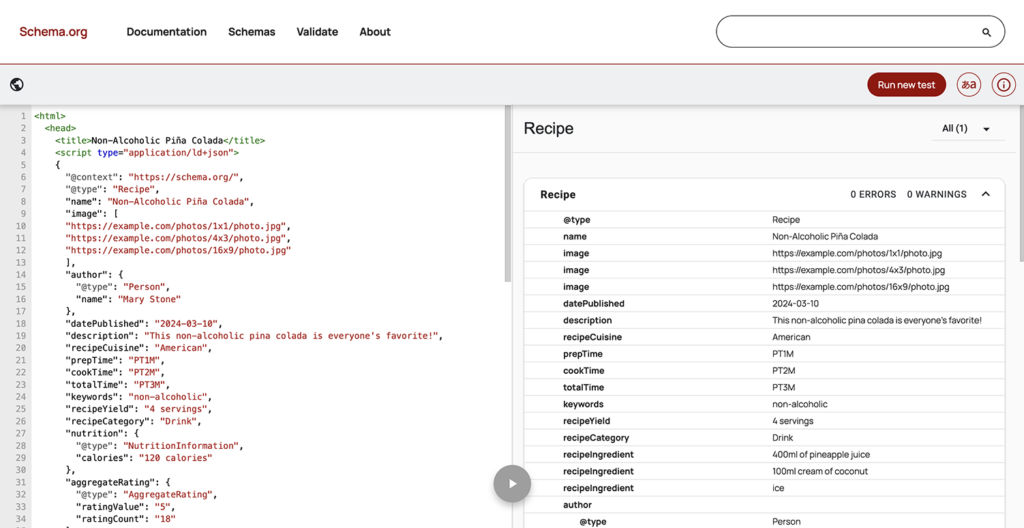
After launch, watch Search Console under Enhancements for structured data errors, and keep an eye on your server logs for AI crawlers like GPTBot, ClaudeBot and PerplexityBot. If your robots.txt blocks them, no amount of markup helps. Google’s Search Central structured data documentation is the reference worth bookmarking for per-type requirements.
What schema mistakes hurt AEO the most?
- Markup that does not match the page. Invisible FAQ answers or a five-star rating with no visible reviews violates Google’s guidelines and erodes machine trust.
- Syntax errors. One missing comma and the whole script is ignored silently. This is why validation is a step, not an option.
- Duplicate or conflicting entities. Two plugins each declaring a different Organization confuses the systems you are trying to help.
- Stale data. Old prices, old hours and departed authors send conflicting signals. Schema needs the same review cycle as the content it describes.
- Generic types. Using Organization when Electrician exists, or Thing when Service exists, throws away the disambiguation that is the entire point.
- Client-side rendering. Schema injected by JavaScript after load may never be seen by AI crawlers, most of which do not render JavaScript. Output it server-side.
Schema also compounds with everything else answer engines read. If your content itself is thin, structured data just labels thin content more clearly, a point we expand on in our breakdown of Google AI Overviews.
Frequently asked questions
Does schema markup guarantee my business gets cited by ChatGPT or Google AI Overviews?
No. Schema markup improves how reliably machines parse and attribute your content, but citations depend on content quality, entity consistency, crawl access and third-party mentions. Research from AirOps found well-structured pages with schema earned around 2.8 times more AI citations, so it clearly helps, but it is one signal among many.
Which schema types should an Australian service business add first?
Start with Organization or a specific LocalBusiness subtype on your homepage, then Service markup on each service page, Article with a named Person author on blog posts, and FAQPage on pages with visible FAQs. That four-type stack covers entity identity, offerings and question-style retrieval, which is where answer engines do most of their matching.
Is JSON-LD better than Microdata for AEO?
Yes, use JSON-LD. It is the format Google recommends, it sits in a single script block instead of being woven through your HTML, and it is far easier to template and update at scale. Microdata and RDFa still validate, but they complicate maintenance and offer no AEO advantage in return.
Where does schema markup go in WordPress?
Let your SEO plugin output it rather than pasting code into theme templates. In Rank Math, configure business details under Local SEO for site-wide entity markup, use the Schema tab in the post editor for Article and Service types, and use the FAQ block so your visible FAQs and FAQPage markup stay identical automatically.
How do I check my schema markup is working?
Run the page through Google’s Rich Results Test for eligibility and errors, then through the Schema.org validator for types Google does not test. After that, monitor Search Console’s Enhancements reports for new errors and confirm AI crawlers like GPTBot and ClaudeBot are not blocked in your robots.txt file.
Get your schema and AI visibility sorted properly
Schema markup is a few hours of careful setup that keeps paying off every time an answer engine crawls your site. If you would rather have it implemented, validated and connected to a full answer engine optimisation strategy, that is exactly what we do, alongside GEO for visibility in ChatGPT and Gemini. We do this for law firms, professional services firms, construction businesses and energy companies across Australia. Book a free strategy session and we will audit your current structured data and show you what is holding your AI visibility back.