

Most Australian builders start with lead platforms because they work immediately. You pay, enquiries appear, and there is nothing to build. The problem shows up later: the same enquiry usually goes to several builders, you compete on price against people you have never met, the customer arrives already comparing quotes, and none of it accumulates. Stop paying and it stops the same day.
This guide covers what shared leads actually cost once you account for the win rate, what owned channels cost by comparison, and how to build a pipeline that keeps working when you stop spending.
Key takeaways
- Shared leads are sold to multiple builders, so your effective cost is the lead price divided by your win rate.
- A builder click on Google costs a median $9.12, which makes owned search competitive on cost and better on exclusivity.
- Referral and repeat work remain the highest-converting sources and almost no builder systematises them.
- Owned channels compound. Platform spend does not.
- The realistic answer is a mix, weighted away from platforms over time rather than switched off overnight.
What is actually wrong with bought leads?
Nothing, if you understand what you are buying. The published model of most lead marketplaces is that an enquiry is distributed to several businesses who then compete for it. That model has consequences worth being clear-eyed about.
You are quoting against a shortlist you did not create. The customer contacted the platform, not you, and has no reason to prefer you.
Price becomes the differentiator. When four builders arrive with similar credentials, the conversation moves to cost. That is the worst ground for a quality builder to compete on.
Your effective cost is not the lead price. If a lead costs $80 and you win one in six, your real cost per job is $480 before you count estimating time.
Nothing accumulates. A year of platform spend leaves you with the same pipeline position you started in.
The platform owns the relationship. They hold the customer data, the reviews and the search visibility you helped fund.
None of that makes platforms useless. It makes them a supplement rather than a foundation.
What does a lead actually cost across channels?
| Channel | What you pay for | Exclusive | Compounds | Ongoing after you stop |
|---|---|---|---|---|
| Lead marketplaces | Each enquiry, often shared | No | No | Nothing |
| Google Ads | Clicks at a median $9.12 for builder terms | Yes | No | Nothing |
| Organic search | Content and links once | Yes | Yes | Continues |
| Google Business Profile | Time only | Yes | Yes | Continues |
| Referral systems | Time and relationships | Yes | Yes | Continues |
| Repeat and past-client work | Time only | Yes | Yes | Continues |
Builder CPC from Uprise Digital, Australian Google Ads Cost Benchmarks 2026.
The middle column is the one to weigh. A shared lead and an exclusive one are not comparable products even at the same headline price.
Where should a builder actually get leads?
Five sources, ordered by how much they return per hour invested.
1. Your Google Business Profile
In our study of 65 Australian service searches, a local map pack appeared on 100% of trades searches and sat above the first organic result. Three builders appear before your website does, and which three is decided by profile completeness, categories, service areas, photos and reviews.
This is free, it takes a few hours, and most builders have never finished it. Our SEO guide for builders covers the specifics.
2. Past clients and their networks
The highest-converting lead source in building, and the one almost nobody systematises. A past client who is delighted refers you for years, and a builder who never contacts them again captures a fraction of it.
Build a process: a handover pack, a check-in at three and twelve months, a photograph of the finished project sent to the owner, an annual note. It costs nothing and it produces work that arrives pre-sold.
3. Architects, designers and building designers
Every custom build starts with a design. The person who drew it is asked “who should we get to build this?” on nearly every project.
Two or three genuine relationships with architects or building designers in your area will out-produce any platform subscription. Turn up to their office. Build one of their designs well. Send them the photos.
4. Google Ads on your own terms
At a median $9.12 per click for builder terms, paid search delivers exclusive enquiries at a cost that compares well to shared leads once win rate is factored in. Structure it by project type and qualify before the enquiry reaches your estimator. Our Google Ads guide for builders covers campaign structure and budget.
5. Organic search
Slowest to start, cheapest to hold. Trades keywords in our data carry a median difficulty of 15 out of 100, with ranking pages holding a median of 32 referring domains. That is reachable for a real local builder inside a year, after which the enquiries arrive whether or not you spend anything that month.
How do you make leads worth quoting?
Volume is the wrong target. In building, an unqualified enquiry costs your estimator hours, and the estimating time is your real acquisition cost.
Qualify before the enquiry lands. A multi-step form should capture:
- Project type: new build, extension, renovation, commercial, knockdown rebuild
- Scope: rough size, number of rooms, storeys
- Location: suburb, so you can decline outside your area immediately
- Budget range: bracketed, not exact
- Timeline: ready now, three to six months, twelve months plus
- Design status: plans drawn, concept only, nothing yet
- Ownership: own the land, buying, leased
Expect total enquiries to fall and the share worth quoting to rise. That is the trade working correctly, and it is the reason to stop reporting lead volume as a success metric.
Should you drop lead platforms entirely?
Not immediately, and possibly not at all.
Keep them while you build owned channels, if your pipeline depends on them today. Cutting your only lead source to fund a twelve-month SEO build is how builders end up with neither.
Reduce them as owned enquiries grow. Track cost per signed contract by source and shift budget toward whatever wins.
Use them tactically to fill a quiet month, enter a new suburb, or test demand for a project type before committing to campaigns.
Stop treating them as a foundation. A pipeline you rent is a pipeline that ends the day you stop paying.
What we recommend
Run the arithmetic on your own numbers before changing anything. Take your platform spend for the last twelve months, count the contracts it produced, and divide. Most builders have never done this and are surprised by the answer in both directions.
Then start the owned channels in parallel while platform spend continues. Google Business Profile this month. A referral and past-client process next month. Google Ads once you have project-type landing pages worth sending clicks to. Organic content across the following year.
Twelve months later you have a pipeline that keeps producing on the months you spend nothing, which is the position every building company should be aiming at and few reach.
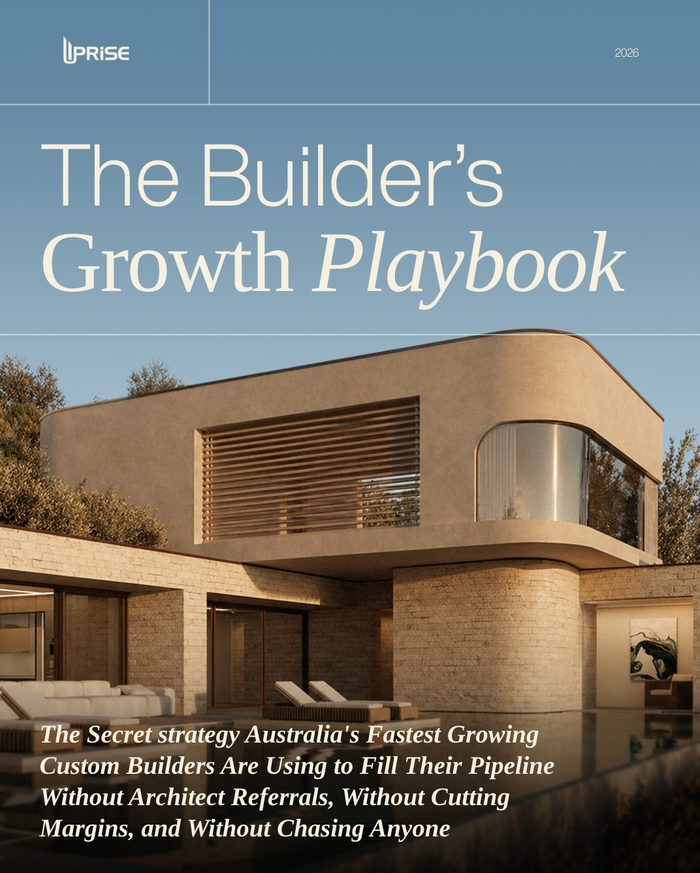
Free Download
The Builder’s Growth Playbook
- The system builders use to turn $50k in ad spend into $5M to $15M in contracted work
- Why the best clients in your market are choosing builders worse than you
- The five mistakes that destroy the result before it has a chance to work
Frequently asked questions
Are lead generation platforms worth it for builders?
They work as an immediate supplement and poorly as a foundation. Leads are typically shared with several businesses, so your effective cost is the lead price divided by your win rate, and nothing accumulates. Use them to fill gaps while you build channels you own.
What is the cheapest way for a builder to get leads?
Your Google Business Profile, which costs time rather than money and appears above organic results on effectively every local building search. After that, past clients and design professional relationships. All three cost hours rather than dollars and all three compound.
How much does a building lead cost in Australia?
It depends entirely on the channel and your conversion rate. Google Ads builder clicks run a median $9.12, so a builder converting at 3% pays roughly $300 per enquiry. Shared platform leads carry a headline price per lead, and the meaningful figure is that price divided by your win rate.
How do I get more custom home building enquiries specifically?
Target custom build searches separately from renovation searches, run a dedicated landing page showing completed custom homes with the design process explained, and build relationships with architects and building designers in your area. Custom build buyers research for months and choose on demonstrated capability.
How do I stop wasting time quoting jobs that go nowhere?
Qualify before the enquiry reaches your estimator. Capture project type, scope, suburb, budget range, timeline and design status on the form. Your enquiry count will drop and your quote-to-contract rate will rise, which is the outcome that matters.
How long does it take to build a pipeline that does not rely on platforms?
Google Business Profile improvements can shift map pack visibility within weeks. Paid search produces enquiries within days once landing pages exist. Organic search generally takes six to twelve months. Plan on a year to change the mix meaningfully, running platform spend alongside until owned channels carry the load.
Want a pipeline you own?
We build lead generation systems for Australian builders and construction companies: Google Business Profile, project-type landing pages, qualification forms, paid search and organic content that keeps working after the spend stops.
See our construction marketing services or book a free construction marketing audit. We will map your current lead sources by cost per signed contract and show you where the leverage is.
Sources
- Uprise Digital (2026), Australian Google Ads Cost Benchmarks 2026
- Uprise Digital (2026), AI Overviews in Australian Service Search