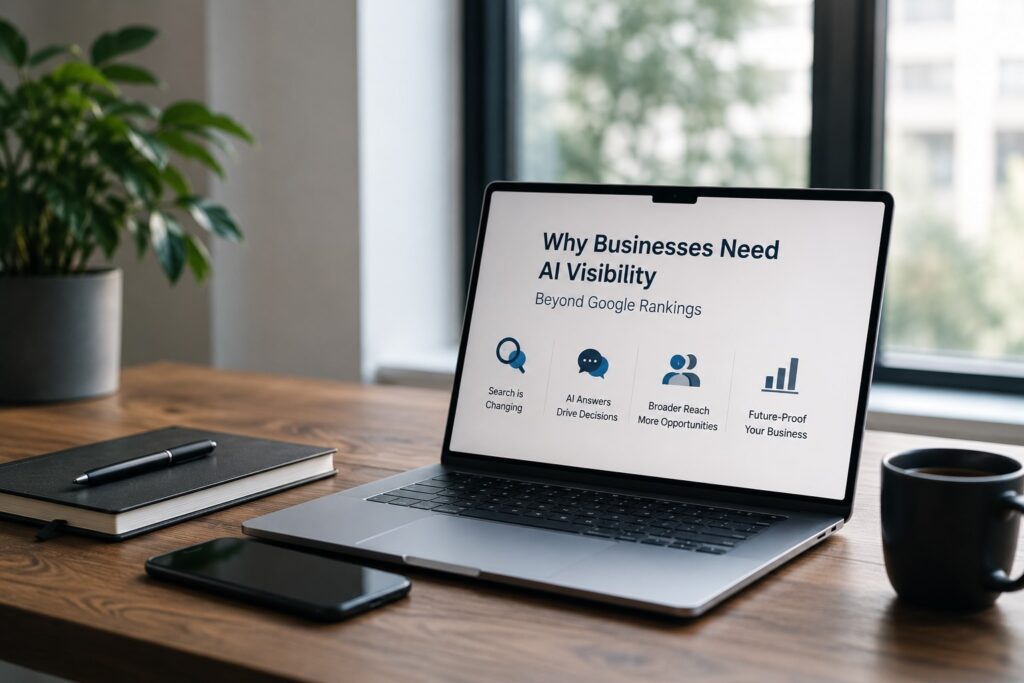
Businesses need AI visibility beyond Google rankings because customers now find answers, and shortlists, inside AI tools like ChatGPT, Gemini, Perplexity, Copilot and Google AI Overviews, often without clicking a website at all. Ranking number one still matters, but it no longer guarantees the traffic or the recommendation it once did. Fewer than one in ten sources cited by AI assistants also rank in Google’s top 10 for the same question, so traditional SEO success does not automatically carry over. Winning now means being visible across every surface where buyers research, which takes two disciplines working together: AI SEO, the technical and content foundation, and generative engine optimisation (GEO), which makes AI understand and recommend your business as a trusted entity.
The problem hiding inside your analytics
Plenty of businesses still judge their online presence by one number: where they rank on Google. For years that was a fair proxy for visibility. In 2026 it quietly stopped being one.
The symptom shows up as a puzzle in the data. Rankings hold steady, or even improve, yet enquiries and traffic soften. Nothing obvious is broken. What has changed is that the customer’s journey now often ends before your website, inside an AI answer that summarises, recommends, and resolves the question on the spot.
If you are measuring only rankings, you are watching one window while the room has moved. This is the gap that proper AI SEO is built to close.
What “AI visibility” actually means
Visibility used to mean a position in a list of ten blue links. Now it means presence across a whole ecosystem of surfaces, each of which can answer a customer before they reach you.
| Old model (rankings) | New model (AI visibility) |
| A position in Google’s organic list | Presence across AI Overviews, ChatGPT, Gemini, Perplexity and Copilot |
| Built on keywords and backlinks | Built on entities, authority and verifiable trust |
| Success measured by clicks | Success measured by citations and recommendations |
| One channel: Google | Many surfaces, each with its own rules |
| Win by ranking | Win by being the source AI cites |
Rankings have not disappeared. They are now one input among several. SERP visibility in 2026 is rankings plus search features plus AI citations, and the businesses that thrive treat all three as the job.
Where your customers actually are now
The shift is measurable, not anecdotal. More than half of Google searches already end without a click, with the answer resolved on the page through AI Overviews, snippets and knowledge panels. Around 89% of brands now appear in AI Overviews at least somewhere, which means simply being present is the baseline rather than the edge.
At the same time, a parallel discovery layer has formed inside AI assistants. People ask ChatGPT or Perplexity a full question, who is the best provider, what should I look for, who should I call, and act on the synthesised answer. For many businesses this traffic is already arriving from chatgpt.com and similar platforms, often invisible in old reports unless you go looking for it.
The uncomfortable detail is the overlap, or lack of it. Fewer than 10% of the sources AI assistants cite also rank in Google’s top 10 for the same query. The pages winning AI citations are frequently not the pages winning rankings, which is why a business can dominate Google and still be absent from the AI answer.
Why Google rankings alone no longer protect you
Three forces are pulling visibility away from the classic ranking.
The click is vanishing
Zero-click behaviour means the answer increasingly lives on the results page or inside the chatbot. Your ranking can be intact while the click it used to earn never happens. Forecasts from analysts like Gartner point to traditional search volume falling materially as AI-driven discovery takes hold.
The engines disagree with Google, and each other
AI assistants build their own view of who is credible. Because so few cited sources match Google’s top results, optimising only for Google leaves most of the AI discovery landscape uncovered. Earning a place in AI answers has been reported as considerably harder than ranking, precisely because the selection logic is different.
AI judges entities, not just keywords
Google rankings rewarded pages and links. AI rewards recognised entities: a clearly defined business, with consistent information, demonstrated expertise and verifiable trust signals across the web. A business that is a strong entity gets surfaced. One that is only a strong keyword target may not.
The shift is structural. For two decades, search optimisation taught businesses to think in keywords: find the phrase, target the phrase, rank for the phrase. AI does not work that way. It builds a model of the world made of entities and the relationships between them, then reaches for the entity it understands best and trusts most when it answers a question. The practical consequence is that a thin page stuffed with the right phrases, which might once have ranked, now gets passed over in favour of a business the model can actually verify and describe with confidence.
The cost of staying rankings-only
The danger is quiet, which is what makes it dangerous. There is no error message when a competitor is named in an AI answer instead of you. There is no alert when a buyer reads a synthesised recommendation and never visits your site. The loss shows up months later as softer enquiry volume that is hard to attribute, long after the advantage has been conceded. Businesses that wait for the trend to become undeniable will be trying to build authority in a field where earlier movers have already become the trusted answer, which is far harder than getting there first.
How AI decides which businesses to surface
Understanding the mechanism shows where to act. When an AI answers a question that involves recommending or describing a business, it runs a short, repeatable process.
| Step | What the AI does | Where you influence it |
| 1. Retrieve | Searches the web and pulls candidate sources | Be crawlable, indexed and present |
| 2. Define the entity | Works out who you are and what you do | Keep your name, details and category consistent everywhere |
| 3. Assess authority | Weighs citations, mentions and referring domains | Earn trusted citations and listings |
| 4. Compare trust | Weighs reviews, credentials and consistency | Build genuine reviews and verifiable signals |
| 5. Surface or recommend | Names the businesses it is most confident about | Win on clarity, authority and structure combined |
This is where AI SEO and GEO meet. AI SEO builds the crawlable, structured, technically sound foundation that gets you into the retrieval pool. GEO shapes how AI understands and trusts your business as an entity, so it surfaces and recommends you. One without the other leaves money on the table.
The two disciplines, working together
| Discipline | What it does | What it delivers |
| AI SEO | Technical foundation, structured data, indexable content | You are findable and machine-readable |
| AEO (answer engine optimisation) | Structures content so AI can extract a direct answer | You get cited in AI answers and Overviews |
| GEO (generative engine optimisation) | Builds your entity and authority across the web | You get recommended by name across engines |
Run together, they move a business from “ranks on Google” to “is the answer”. The same work that makes you legible to AI also makes you clearer and more trustworthy to the human reading the answer, which is rare alignment worth leaning into. The principles are the same whether you are a service business or a professional firm, from local trades through to our work with law firms.
A useful way to hold the relationship: AI SEO gets you into the room, and GEO gets you recommended once you are there. A technically flawless site with no authority is present but never chosen. A well-regarded business with a site AI cannot read or verify is trusted but never found. Most businesses are strong on one side and weak on the other, which is exactly why a deliberate, combined programme tends to produce outsized gains, you are usually fixing a real bottleneck rather than polishing something that already works.
The Australian picture
This is not a future trend for Australian businesses. It is already here. According to research reported in 2026, 58% of Australians aged 14 and over now use AI tools, with ChatGPT the most widely used assistant at well over ten million users. Adoption among Australian businesses is climbing in parallel, tracked by the federal National AI Centre, which reports AI use becoming near-universal among small and medium firms.
The practical implication is simple. Your customers, suppliers and staff are already asking AI tools the questions that used to start on Google. If your business is invisible in those answers, a competitor is being named instead, quietly, every day. The opportunity is explored further in our guide to AI search visibility for Australian businesses.
A self-check you can run this week
You do not need to commit to anything to see where you stand.
- List the ten to fifteen questions a customer asks before choosing a business like yours, in their words.
- Put each one to ChatGPT, Perplexity, Gemini and Google AI Overviews. Note where your business is named, where a competitor is named, and where no one in your market appears.
- Check your analytics for referral traffic from chatgpt.com and perplexity.ai, which for many businesses is already arriving.
- Repeat it monthly, because AI answers shift with model updates.
Most owners get an uncomfortable surprise: competitors recommended for things they assumed they owned. It pairs well with a closer look at how Google AI Overviews are reshaping the results page.
What to actually do about it
The fix is not to abandon SEO. It is to extend it into the surfaces where decisions now happen.
Build a clear entity, with consistent name, category and details everywhere you appear, and structured data that tells machines exactly who you are. Publish genuinely useful, well-structured content that answers your customers’ real questions directly, so AI can lift and cite it. Earn the third-party authority AI verifies, through reviews, reputable mentions and consistent listings. And change what you measure, tracking citation share across AI platforms, not just Google position. The wider toolkit for this sits in our overview of AI tools for digital marketing, and the answer-side of the work is covered in our answer engine optimisation and generative engine optimisation services.
What realistic results look like
AI visibility is a compounding investment, not a switch you flip. Entity clarity and content structure move faster. Authority, reviews and recognition take time. Early progress shows up as appearing in AI answers for more of your target questions and growing referral traffic from AI platforms.
No one can honestly promise a guaranteed slot in an AI answer, because there is no fixed position to buy and cited sources change month to month. What good AI SEO and GEO do, done well, is steadily raise the probability that your business is the one trusted enough to be named. In a landscape where most competitors are still measuring only rankings, that head start compounds.
Why Uprise Digital
Plenty of agencies added “AI” to their service list this past year. Far fewer understand how these systems actually choose what to surface. That gap is where Uprise Digital works.
We treat AI visibility as a credibility-engineering problem, not a keyword one. The work starts with an AI visibility audit across ChatGPT, Perplexity, Gemini, Copilot and Google AI Overviews, so you know exactly where your business is named, where competitors appear instead, and what that gap is costing you. From there we build the entity clarity, structured content, and verifiable authority that move the needle, on solid AI SEO for businesses foundations. We report honestly, on AI citations and not just Google rankings, and we will always tell you plainly what this work can and cannot do.
How to take the next step
If you would rather not guess, the sensible first move is an AI visibility audit: a clear baseline of where you are surfaced, where you are absent, and what to fix first.
The businesses AI recommends in 2026 are the ones doing this work in 2026, not the ones assuming their Google rankings will quietly carry over. They mostly will not.
FAQ
What is AI visibility?
AI visibility is how often, and how prominently, your business is surfaced or recommended across AI-driven discovery surfaces, including Google AI Overviews, ChatGPT, Gemini, Perplexity and Copilot. It goes beyond a Google ranking to your presence inside the answers customers now read.
Are Google rankings still worth pursuing?
Yes, but they are no longer the whole job. Rankings help feed AI systems and still drive some clicks, but with more than half of searches ending without a click and fewer than 10% of AI-cited sources ranking in Google’s top 10, rankings alone leave most of the discovery landscape uncovered.
What is the difference between AI SEO and GEO?
AI SEO is the technical and content foundation that makes your business findable and machine-readable. GEO (generative engine optimisation) builds the entity and authority signals that make AI understand and recommend your business. They work best together.
How do I know if my business is invisible to AI?
Run the self-check above: ask the major AI tools the questions your customers ask, and note whether you are named. Many businesses discover competitors being recommended for terms they assumed they owned.
Is this relevant to small and local businesses?
Very. AI tools now routinely recommend providers, and AI local visibility has been reported as significantly harder to earn than a Google ranking. Smaller businesses that act early can establish authority before their market wakes up to the shift.
How do I measure AI visibility when there is no click?
Through citation share: regularly prompting the major AI platforms with your real customer questions and recording whether your business appears, who appears instead, and what they are cited for. Track it monthly rather than relying only on rankings.
Key takeaways
- More than half of Google searches now end without a click, so a top ranking can leak most of its traffic to the answer on the page.
- Around 89% of brands already appear in AI Overviews, which makes multi-surface presence the new baseline, not a bonus.
- Fewer than 10% of sources cited by ChatGPT, Gemini and Copilot also rank in Google’s top 10, so strong SEO does not guarantee AI visibility.
- Earning visibility inside AI answers has been reported as far harder than ranking in Google, because AI selects on entity clarity and authority, not keywords alone.
- In Australia, 58% of people aged 14 and over now use AI tools, led by ChatGPT, so your customers are already researching this way.
- The winning approach combines AI SEO and GEO: a strong technical and content foundation plus the entity and authority signals AI trusts.
Resources
These external sources inform the data and claims in this article, and are useful authority references on AI search and modern business visibility:
- Google, Generative AI in Search guidance: official documentation on AI Overviews and AI features in Search.
- OpenAI: primary source on ChatGPT search and how the assistant retrieves and cites the web.
- Australian Government, National AI Centre: official insights on AI adoption among Australian businesses.
- Gartner Newsroom: forecast that traditional search volume will fall around 25% by 2026.
- Pew Research Center: research on search behaviour and zero-click sessions when AI answers appear.
- Wikipedia, Zero-click search: background on the zero-click phenomenon.
- Wikipedia, Generative engine optimization: background on optimising for AI-generated answers.