
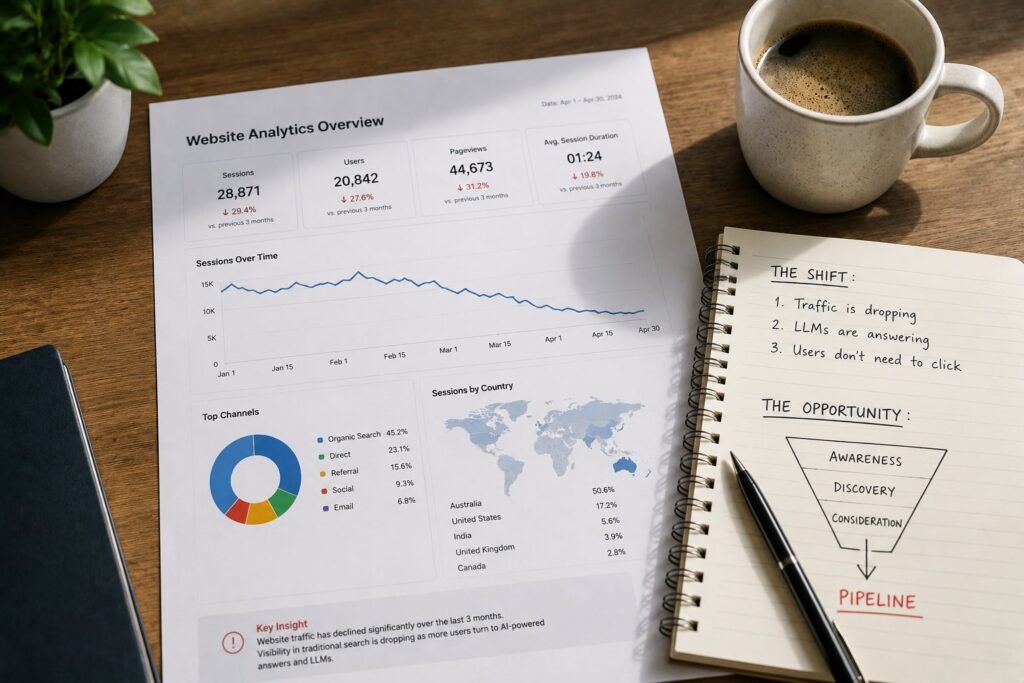
Your website traffic is dropping after LLMs because search now answers questions on the results page instead of sending clicks to your site. Google AI Overviews appear on a large share of Australian searches, and tools like ChatGPT, Perplexity and Gemini answer directly without a click. Around 60% of searches now end without one, rising to roughly 80% when an AI summary appears. Your rankings did not fall; the page around them changed. The fix is AI SEO, combining answer engine optimisation (AEO) and generative engine optimisation (GEO) with traditional SEO, so your brand is the source AI cites and recommends.
In 2023 and 2024 you finally cracked page one on Google.com.au for your best keywords. In 2026 those rankings still look healthy in your SEO tool, yet organic traffic is down, enquiries are lumpy, and your team keeps asking what happened to all that SEO work.
You did not get hit by a secret penalty. Search itself evolved, first in the United States and now firmly in Australia. Google has rolled out AI Overviews locally as part of a global expansion, placing generative summaries directly on the results page, while ChatGPT, Perplexity and Gemini increasingly answer questions outright. The demand is still there. It simply changed front doors. This article shows why the drop is happening and gives Australian brands a practical framework to convert the shift into pipeline. For the wider context, our pillar on AI search visibility frames the change across every sector.
LLMs didn’t kill demand. They changed how Australians search.
The mistake is reading a traffic drop as lost demand. People are searching as much as ever, and total information-seeking has actually grown. What changed is where the answer is delivered and who gets credited for it.
AI Overviews now resolve “what is” and “how to” queries on the results page itself, cutting clicks to blogs and guides. Zero-click behaviour, where users get what they need from an AI summary, snippet, local pack or knowledge panel, is rising, especially on mobile. The result is a familiar pattern for Australian businesses: fewer blog visits, but steady calls and enquiries, because people now act directly from the SERP, Maps or an AI widget.
The shape of the shift differs by business type. A Sydney SaaS founder sees fewer visits to “what is X software” pages but more branded searches like “[product] pricing” and “[product] reviews.” A Melbourne e-commerce store loses generic traffic such as “best running shoes Australia” while converting better on product and category pages built for rich results. A Brisbane tradie gets less blog traffic but steady calls from their Google Business Profile and map pack presence, a pattern we see often with Australian service businesses. Classic SEO still matters, but on its own it no longer explains why some Australian brands grow while others flatline. That gap is where AI SEO comes in. We unpack the underlying shift in our guide to how AI search is changing SEO.
Three reasons Australian website traffic drops as LLMs evolve
Across Australian SaaS, e-commerce and local businesses, a traffic drop usually traces to one of three causes.
1. AI Overviews and zero-click SERPs (an AEO problem). Google’s AI Overview is now active for many Australian users, summarising answers directly above the results. Studies link these summaries to click-through drops of roughly 34% to 60% on informational keywords, and in some large user studies traditional results are clicked around half as often when an AI summary is present. Your position two on Google.com.au now sits under an AI box, a People Also Ask block and perhaps a local pack. Your ranking did not get worse; the page around it changed. Our explainer on Google AI Overviews breaks down how this surface behaves.
2. Generative engines answer in place (a GEO problem). Australians increasingly ask ChatGPT, Perplexity and Gemini things like “best CRM for Australian small business” or “alternatives to [tool] for Aussie startups,” and get an instant synthesised answer. These engines pull from multiple sources and sometimes cite them, but users often do not click unless they are ready to go deeper. Generative engine optimisation is about making sure your brand is part of those suggested answers rather than invisible background data.
3. Australians ask longer, more specific questions. Conversational queries now carry location (“SEO agency in Melbourne for e-commerce”), regulation (“HRIS that handles Fair Work compliance”) and locale-specific needs (“NBN modem for regional NSW”). Zero-click features and AI Overviews are most aggressive on exactly these informational and local queries. If your keyword strategy is still built around short, generic phrases, you miss the long queries where LLMs are doing the most work.
What AI SEO actually means for Australian brands
“AI SEO” can sound like buzzword bingo. In practice it is three connected disciplines working together, built on solid AI SEO foundations.
Answer engine optimisation (AEO) shapes your content so AI Overviews and answer boxes can extract and trust it. For Australian sites that means clear headings and short paragraphs, a direct 40 to 60 word answer at the top of key pages in natural Australian English, concise FAQ blocks that mirror real customer questions (“Do you ship across Australia?”), and simple tables to summarise comparisons or coverage. The goal is to make it easy for an AI Overview to treat your page as the definitive answer for an Australian user. This is the heart of answer engine optimisation.
Generative engine optimisation (GEO) is optimisation for ChatGPT, Perplexity, Gemini and similar tools. For Australian brands it means creating content around the real prompts locals use (“ATO-compliant accounting software for tradies,” “family lawyer in Melbourne for custody cases”), and ensuring your brand appears on the sources these engines trust: local media, Australian directories and relevant AU blogs and communities. The aim is to become a default recommendation when someone in Australia asks an LLM for options in your category.
LLM-first content and technical foundations keep your site friendly to both humans and models. Implement the right schema (LocalBusiness, Organization, Product, FAQ, HowTo), write with clear and consistent entity definitions for your brand, products and locations, and create original data, frameworks and comparisons worth citing, such as an “Australian payroll software comparison 2026” rather than a generic listicle.
Done together, SEO, AEO and GEO help you rank on Google.com.au, appear in AI Overviews, and get mentioned inside the generative answers Australians rely on.
Different playbooks for SaaS, e-commerce, local and agencies
| Business type | Main risk | AI SEO focus |
| SaaS | Losing top-funnel discovery to US-centric competitors in AI summaries | AU-context comparison pages; prompts with “Australia”; local thought leadership |
| E-commerce | Marketplaces and big retailers dominating AI suggestions | “Australian-made” signals; AU buying guides; Product and review schema |
| Local | Zero-click local search; fewer visits, same or more calls | Tight service pages and FAQs; optimised Google Business Profile; AU reviews |
| Agencies | Clients assuming “SEO stopped working” | Productised AEO/GEO services; reporting tied to leads, not just sessions |
For SaaS founders, AI Overviews often list a small set of tools with location-agnostic summaries; if you do not signal Australian compliance or presence (ATO, ASIC, Fair Work, local support hours), you are excluded. For e-commerce, AI answers may favour large brands unless you clearly communicate Australian origin, certifications and shipping. For local businesses, local packs and knowledge panels answer the whole query, so your Google Business Profile and reviews matter more than blog content. For agencies, zero-click effects distort standard rankings-and-sessions reporting, so the firms that explain AI Overview presence and pipeline outcomes keep client trust.
The LLM-era traffic recovery framework
Here is a practical five-step framework Australian brands can apply.
Step 1, Diagnose: is it AI or relevance? List your top 25 to 50 money keywords on Google.com.au. For each, check whether an AI Overview appears, how your click-through changed, and whether traffic dropped around the 2025 to 2026 AI rollout. Segment into AI-impacted, competition-impacted, and stable opportunities. This tells you where AI SEO matters most.
Step 2, Rebuild key pages as AI-citable (AEO). Take your 10 to 20 highest-value pages and add a 40 to 60 word direct answer at the top in plain Australian English, clear headings per sub-topic, bullet points, one simple table, and FAQ content marked up with FAQ schema. Make it easy for an AI Overview to surface you as a definitive, locally relevant answer.
Step 3, Seed your brand in generative engines (GEO). Extract longer, AU-specific queries from Search Console, then create content targeting that exact language. Build presence on Australian-relevant sources: local business hubs, AU blogs, industry media and directories. The more trusted Australian contexts your brand appears in, the more likely LLMs mention you for Australian users.
Step 4, Own zero-click local and e-commerce surfaces. For local businesses, optimise your Google Business Profile thoroughly (categories, services, hours including public holidays, service areas, photos, posts) and encourage detailed reviews mentioning specific suburbs and outcomes. For e-commerce, use Product and review schema with descriptions tailored to Australian buyers (shipping, GST, returns), and write buying guides that spell out “best X in Australia for Y.”
Step 5, Shift your KPIs. Replace a traffic-only view with measures that fit AI-driven search: AI Overview presence and movement for key queries, share of branded versus non-branded search in Australia, and direct enquiries, calls and orders attributed to organic-influenced journeys. For agencies, tie AI SEO work to leads, bookings and revenue rather than sessions alone.
What realistic recovery looks like
It is worth being candid, because this space attracts inflated promises. AI visibility is a compounding investment, not a switch. Authority, entity recognition and content depth build over months, and brands that started early are harder to displace. Page structure and freshness move faster.
What no one can honestly offer is a guaranteed position in AI answers. There is no fixed slot to buy in ChatGPT or AI Overviews, results shift with phrasing and model updates, and cited sources genuinely churn. Anyone promising guaranteed AI rankings is selling a fiction. What proper AI SEO does, done well, is steadily raise the probability that your brand is the source trusted enough to be cited, and convert that visibility into pipeline.
Why Uprise Digital leads on AI SEO in Australia
Plenty of agencies added “AI” to their service list this past year. Far fewer rebuilt their methodology around how AI actually selects and cites sources, or how to translate that into enquiries. That is the work Uprise Digital does.
We treat AI visibility as a credibility-engineering problem, not a keyword one. Engagements begin with an AI visibility audit across Google AI Overviews, ChatGPT, Perplexity, Gemini and Claude, so you know exactly where you appear, where competitors are cited instead, and what the gap is costing you. From there we apply the recovery framework above, integrated across SEO, AEO and GEO rather than bolted on, and report honestly on AI citations and pipeline, not just traffic graphs. For Australian SaaS, e-commerce, local and agency clients watching their rankings hold while traffic erodes, that combination of evidence-based method and straight talk is what sets Uprise Digital apart.
FAQ
Has Google AI Overview launched in Australia?
Yes. Google expanded AI Overviews to over 100 countries, and Australian users now see AI-generated summaries for many queries, tuned to local context. Australian businesses face the same zero-click and AI-answer pressures seen in the US and UK.
Why is my traffic dropping when my rankings look fine?
Because AI Overviews and zero-click features answer the query before users reach your listing. Your position has not changed; the results page around it has, absorbing the clicks that used to come to you.
Will zero-click searches hurt my local business?
Mostly they hurt informational blog content. Local customers may still call, request directions or message you straight from Google or Maps, so your Google Business Profile and local SEO become core assets rather than a bonus.
Is AI SEO different in Australia versus the US?
The principles are the same, but execution must reflect Australian realities: local regulations, tax laws, spelling, slang and regional preferences. AI Overviews and models adapt to local content, so optimising with Australian context genuinely matters.
How does AI SEO turn visibility into pipeline?
By making you the cited answer for high-intent Australian queries, then converting that on pages built to act on. AI-referred visitors arrive pre-informed and tend to convert well, so the focus is enquiries and sales, not impressions.
Can I recover traffic I have already lost?
Often the better goal is recovering pipeline rather than raw sessions. Rebuilding key pages as AI-citable, seeding generative engines and owning local surfaces can restore enquiries even when some informational clicks do not return.
Where this leaves Australian brands
The drop in your traffic is not a failure of your old SEO. It is the search environment changing around it, faster in Australia than in most markets. Demand did not disappear; it moved to front doors you have not optimised for yet. The brands being cited inside AI answers are quietly compounding an advantage while everyone else stares at a declining sessions chart.
If you would rather not guess, the sensible first move is an AI visibility audit: a clear baseline of where you are cited, where you are absent, and what to fix first. The brands that turn the LLM shift into pipeline in 2026 are the ones doing this work in 2026, not the ones waiting for the clicks to come back. They mostly will not.
Ready to be the answer instead of the afterthought? Uprise Digital builds AI SEO programmes for Australian brands that turn AI visibility into real pipeline. See how we get you cited with generative engine optimisation, or start with the bigger picture in our guide to AI search visibility in Australia.
Key takeaways
- Falling traffic with stable rankings is the signature of AI search, not a Google penalty; the results page changed around your listing.
- Around 60% of searches end without a click, climbing to roughly 80% on queries where an AI Overview appears.
- Demand has not disappeared. It moved to new front doors: AI Overviews, ChatGPT, Perplexity and Maps.
- Recovery means rebuilding key pages to be AI-citable, seeding your brand in generative engines, and owning zero-click local and product surfaces.
- The right KPI is no longer sessions alone, but AI citation presence, branded search and enquiries.
Resources
These external sources informed the data and claims in this article, and are useful authority references for the LLM-era search shift:
- Google, The Keyword blog: official announcements on the AI Overviews global rollout, including Australia.
- Google, Generative AI in Search guidance: official documentation on AI features and AI Overviews in Search.
- OpenAI: primary source on ChatGPT search and how the assistant retrieves and cites the web.
- Gartner Newsroom: forecast that traditional search volume will fall around 25% by 2026.
- Pew Research Center: research on search behaviour and how users end sessions when AI answers appear.
- SparkToro: zero-click search analysis with Datos, showing most searches end without a click.
- Search Engine Land: ongoing reporting on AI search behaviour and SERP changes.
- Wikipedia, Zero-click search: background on the zero-click phenomenon.