Most solar installers do not have a marketing problem, they have a journey problem. They run a Google Ads campaign over here, boost a couple of Facebook posts over there, and send a quote follow-up email if someone remembers to. None of it is joined up, so buyers fall through the gaps between the moment their power bill scares them and the moment they sign a contract.
That gap is wide. The Australian residential solar buyer rarely decides in a single session. They sit with the idea for weeks, get three or more quotes, read reviews late at night, ask a neighbour who already has panels, and worry quietly about being ripped off by a dodgy installer. If your marketing only shows up at the very start or the very end, you are paying to warm up leads that someone else closes.
This guide maps the real journey end to end and shows you which channel, which message and which metric matters at each stage. The goal is simple. Stop running disconnected campaigns and start running one connected system that moves a homeowner from “is solar even worth it” to “where do I sign”.
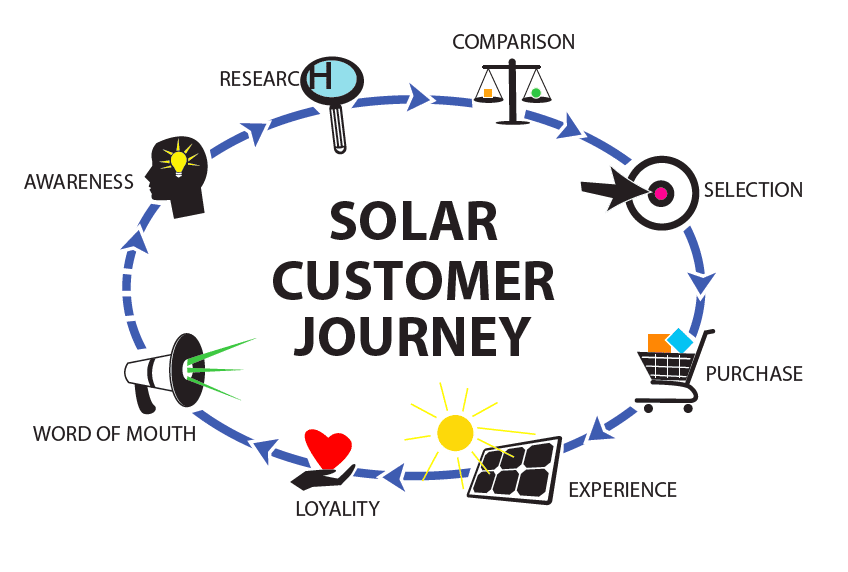
The Australian solar customer journey runs through six stages: trigger, active research, shortlisting and multi-quote, decision, install and onboarding, and advocacy. It typically takes six to twelve weeks from the first power-bill shock to a signed contract, and most buyers collect three or more quotes before deciding. Installers win that journey not by being the cheapest but by being the most trusted and the fastest to respond, then by turning every install into reviews and referrals that feed the next buyer’s research stage.
Map your marketing to six buyer stages instead of running random campaigns. Use SEO, GEO and social to win the trigger and research stages, search ads and comparison content to win shortlisting, and reviews, proof and fast follow-up to win the decision.
The journey takes six to twelve weeks and involves three or more quotes, so stop chasing last-click attribution and start instrumenting the whole path. Then close the loop: every happy install should generate reviews and referrals that fuel the next buyer’s research.
Why does mapping the solar customer journey matter for installers?
Because the residential solar purchase is high consideration and slow. A homeowner is spending many thousands of dollars on a product bolted to their roof for two decades. They do not impulse buy. They research, compare and second guess, often across six to twelve weeks and sometimes longer when finance or a battery is involved.
The Clean Energy Regulator’s data shows millions of small-scale systems installed across Australia under the Small-scale Renewable Energy Scheme, and the market is mature rather than novel. That maturity matters. Buyers now arrive with opinions, fears and a friend who got burned. You can read the official scheme detail on the Clean Energy Regulator site.
When you map the journey, you can see exactly where your marketing is silent and where buyers leak out. Most installers are loud at the start (awareness ads) and at the end (quote follow-up) but completely quiet in the messy middle where the actual decision gets made. That middle is where trust is won or lost.
A journey map also fixes the attribution arguments. When you can name the stages, you can stop crediting the last click for a sale that took eleven weeks and a dozen touches. More on that further down.
What triggers an Australian homeowner to consider solar?
Almost nobody wakes up wanting solar panels. Something pushes them. The three most common triggers we see are a brutal quarterly power bill, a rebate or price headline in the news, and a neighbour or family member who just got panels installed.
The bill shock is the strongest. When a household opens a summer or winter electricity bill that is markedly higher than expected, the pain is fresh and specific. The Australian Energy Regulator tracks retail electricity prices and the Default Market Offer, and price movements there ripple straight into search demand. You can see current pricing context at the Australian Energy Regulator.
The neighbour trigger is quieter but powerful. Visible panels on a similar house on the same street remove a lot of perceived risk. This is social proof in its rawest form, and it is why local density of installs compounds: every job you do makes the next street more likable.
At the trigger stage the buyer is not searching for your brand. They are searching for the problem. Queries look like “why is my power bill so high”, “is solar worth it in Brisbane 2026” or “how much do solar panels cost Sydney”. Your job here is to be present in those answers, not to pitch. This is awareness, and it is owned by content, not by a hard sell.
What are the stages of the solar buyer journey, and how long do they take?
Here is the full path, with realistic Australian timelines. Treat these as the spine of your marketing calendar.
Trigger and awareness (week zero to two). The bill lands, the curiosity starts. The buyer reads a couple of articles, maybe watches a video, and forms a vague intention. They are not ready to talk to a salesperson.
Active research (week one to four). Now they are learning. Cost, payback period, system size, rebate eligibility, battery or no battery. They are reading comparison content, checking what a 6.6kW versus a 10kW system means, and starting to form a budget. This is where most of the education happens.
Shortlisting and multi-quote (week three to eight). They request quotes. The Clean Energy Council, which administers the Approved Seller and accredited installer frameworks, openly advises consumers to get multiple quotes from accredited businesses. Most buyers take that advice and get three or more. You can see the consumer guidance at the Clean Energy Council.
Decision (week six to twelve). They compare the quotes, not just on price but on trust, reviews, panel and inverter brands, warranty and how the salesperson made them feel. The fastest, clearest and most credible installer usually wins here, even at a slightly higher price.
Install and onboarding (week eight to sixteen). Contract signed, then scheduling, install day, grid connection paperwork and meter changes. This stage shapes whether the customer becomes an advocate or a complainer.
Advocacy (month four onward). Once the bills drop and the system proves itself, the happy customer becomes a review writer and a referrer, feeding the trigger stage for the next buyer. Most installers ignore this stage entirely, which is a waste of the cheapest leads they will ever get.
How does each stage map to channels, content and KPIs?
This is the operating map. Each stage has a buyer intent, the channel that best reaches them, the content asset that does the work, and the one metric you should watch. If a stage has no asset and no metric in your business, that is where you are leaking buyers.
| Journey stage | Buyer intent | Primary channel | Content asset | KPI to watch |
|---|---|---|---|---|
| Trigger and awareness | “Is solar worth it for me?” | SEO, GEO, social | Cost and payback guides, short video, local case stories | Organic and AI-cited impressions |
| Active research | “How much, what size, what rebate?” | SEO, email, retargeting | System sizing tools, rebate explainers, FAQ pages | Engaged sessions, return visits |
| Shortlisting and multi-quote | “Who do I trust to quote?” | GEO (AI shortlists), Search Ads, local SEO, comparison content | Accreditation and price ranges in plain text, “Best installer in [city]” pages, Google Business Profile, quote form | AI shortlist mentions, quote requests, cost per lead |
| Decision | “Which of my three quotes wins?” | Reviews, email and SMS, sales follow-up | Reviews, warranties, references, fast personalised proposal | Quote-to-close rate, speed to lead |
| Install and onboarding | “Did I make the right call?” | Email, SMS, phone | Status updates, install-day comms, handover pack | On-time install rate, CSAT |
| Advocacy | “Who should I tell?” | Review requests, referral program | Review ask sequence, referral incentive, performance check-in | Reviews per install, referral rate |
Read the table top to bottom and you will notice the channel shifts from “found” to “trusted”. Early on you need to be discoverable in search and AI answers. Late on you need to be believable. Most installers over-invest in the discoverable end and starve the believable end, which is exactly backwards for a high-trust purchase.
What do solar buyers actually search and worry about at each stage?
Match your content to the real question and you will outrank installers who only publish glossy product pages. The questions evolve as the buyer moves down the journey.
Trigger. “Why is my electricity bill so high”, “is solar worth it in 2026”, “do solar panels actually save money”. The fear here is wasting money on a fad. Reassure with plain payback maths and local examples.
Research. “How big a solar system do I need”, “6.6kW vs 10kW”, “what is the solar rebate in [state]”, “do I need a battery”. The fear is buying the wrong size or missing a rebate. Answer with sizing logic tied to typical household usage and current scheme detail.
Shortlisting. “Best solar installer [city]”, “[brand] reviews”, “is this installer accredited”, “solar quote near me”. The fear is the dodgy installer. The ACCC has repeatedly warned consumers about misleading solar claims and pushy sales tactics, which you can reference at the ACCC. Counter this fear with accreditation, transparent pricing and visible reviews.
Decision. “[Your business] vs [competitor]”, “are these panels good”, “warranty on solar inverters”, “what happens if my installer goes bust”. The fear is regret. Proof, warranty clarity and references close the gap.
If you want to capture the AI-answer surface that increasingly fronts these questions, our guide to AEO for solar companies walks through how to become the cited source in ChatGPT and Google’s AI answers, and our SEO for solar companies playbook covers the organic foundations.
How should installers handle the multi-quote reality?
Accept it. You are almost never the only quote. The buyer has, on average, three or more proposals on the kitchen table, and a slice of them came through aggregators who sold the same lead to several installers at once. If your whole strategy is “be cheaper”, you are competing in a race that crushes your margin and attracts the worst customers.
Winning the multi-quote stage comes down to two levers that have nothing to do with price: trust and response speed. Speed to lead is the single most underrated metric in solar. A homeowner who fills in three quote forms in one evening will reward whoever calls back first, because that responsiveness signals reliability for the whole project.
In practice, the installer who responds within minutes rather than hours wins a disproportionate share. The first credible voice on the phone frames the comparison, sets the questions the buyer asks the other two quotes, and anchors expectations. By the time competitors call back the next afternoon, the deal is half lost.
Trust is the second lever. A consistent stream of recent reviews, clear accreditation, named panel and inverter brands, and a proposal that actually addresses the buyer’s roof and usage beats a cheaper but generic quote. We unpack the trade-off between cheap volume and quality in solar lead quality vs quantity, and the aggregator dynamic in detail in solar aggregator leads vs direct.
Which channels move buyers at each stage, and how do they fit together?
No single channel owns the whole journey, which is why single-channel installers struggle. Think of channels as relay runners passing the baton, not as competing teams.
SEO and GEO carry the top. When the bill shock hits, the buyer searches. If your cost guides, rebate explainers and local pages rank, and if AI answers cite you, you enter the consideration set for free and early. Pair organic with strong local SEO for solar installers so you appear in the map pack when intent turns local.
Social builds familiarity in the middle. Meta and short video keep you present while the buyer mulls it over for weeks. This is not a direct-response job at the awareness stage; it is recall building. Our Meta ads for solar companies 2026 playbook covers the creative and targeting that works.
Search Ads capture the shortlisting hand-raise. When the buyer types “solar quote [suburb]”, that is bottom-of-funnel intent, and paid search lets you appear instantly even before your SEO matures. See Google Ads for solar companies for structure, and Google Ads vs Meta Ads for how to split budget between the two.
Reviews, email and fast human follow-up close the decision. Once the quote is in, the channels that matter are your review profile, your follow-up cadence and the speed of a real person calling back. Google’s own guidance on helpful, people-first content and structured data applies here too; the Google Search Central documentation is the canonical reference for review and FAQ markup that surfaces your proof in search.
If you want the full demand-generation picture across all of these, our pillar guide to solar lead generation in Australia ties the channels together, and the Uprise solar marketing service page shows how we run them as one system.
Why does last-click attribution mislead solar installers?
Because a six to twelve week journey with a dozen touches gets crushed into a single line of credit for whatever the buyer clicked last. Last click almost always over-credits branded search and the final paid ad, and almost always under-credits the SEO article, the social video and the review profile that did the real persuasion weeks earlier.
Here is the trap. You look at last-click data, see that branded Google Ads “drives” most conversions, so you cut the SEO and social spend that fed the brand searches in the first place. Three months later your pipeline dries up and you cannot work out why. You amputated the top of your own funnel.
The fix is not perfect attribution, which does not exist for a journey this long and this offline. The fix is instrumenting the journey so you can see movement between stages, not just the final click. Track assisted conversions, ask every lead “how did you first hear about us”, watch branded search volume as a proxy for awareness spend working, and measure stage-to-stage conversion rates rather than crediting one channel.
We go deeper on the cost benchmarks that anchor measurement in 2026 solar cost per lead benchmarks.
Where do installers lose buyers along the journey?
Leaks are predictable, and they cluster in three places. Find yours and you will recover sales you are currently paying competitors to close.
Slow response at the shortlisting stage. This is the biggest leak by far. A lead that waits hours or until the next day for a callback is a lead you have effectively gifted to the first installer who picked up the phone. If your speed to lead is measured in hours, you are losing winnable deals every week.
Weak proof at the decision stage. A buyer holding three quotes will pick the one that feels safest. Thin reviews, no named brands, no references and a generic proposal all read as risk. The ABS reports that a large and growing share of Australian dwellings have rooftop solar, which means buyers can easily find a neighbour with a better story than your missing one. Household energy and dwelling data sits with the Australian Bureau of Statistics.
No nurture in the middle. The buyer who is not ready today is not a lost lead, but most installers treat them as one. With a six to twelve week journey, the homeowner who downloaded your cost guide in week one is ready to quote in week four, and if you sent nothing in between, you are invisible when they re-enter the market. A simple email and retargeting sequence catches them.
A fourth, quieter leak sits after the sale: doing nothing at the advocacy stage. Every install that does not generate a review or a referral is a missed free lead, and free leads are the only kind that get cheaper as you scale.
How do you turn installs into the advocacy loop?
The journey does not end at handover. It loops. A happy customer at month four is the cheapest, highest-converting lead source you have, because they feed reviews into the shortlisting stage and referrals into the trigger stage for the next buyer.
Make the review ask systematic, not random. Send a request a few weeks after install once the first lower bill has landed and the customer feels the win. Time it to the proof point, not to handover, because gratitude peaks when the savings are visible. A structured sequence consistently outperforms hoping the customer remembers.
Referrals need a reason and a mechanism. A modest incentive for both the referrer and the new customer, plus an easy way to pass your details to a neighbour, turns the natural “who did your panels” conversation into a tracked lead. Given how strong the neighbour trigger is, a single happy install on a street can seed several more.
Reviews then compound back into the top of the funnel. They lift your Google Business Profile ranking, feed AI answers that cite credible local businesses, and reassure the next shortlister.
How should you instrument the solar customer journey?
You cannot manage what you cannot see. Instrumenting the journey means putting one metric on each stage and reviewing them together, so a dip in week-one awareness explains a dip in week-eight quotes two months later.
Start with the stage KPIs from the table: organic and AI impressions for awareness, engaged sessions for research, quote requests and cost per lead for shortlisting, quote-to-close rate and speed to lead for decision, on-time install and satisfaction for onboarding, and reviews and referrals per install for advocacy. Six numbers, one dashboard, reviewed monthly.
Then connect them. Tag every lead with a first-touch source and a quote-request date, track days from first touch to signed contract so you know your true journey length, and watch branded search volume as the canary for whether your awareness spend is actually working. None of this requires expensive software, just discipline about capturing source and dates at the point of lead intake.
Finally, make sure your website is built to convert the traffic you instrument, because a leaky site wastes every channel feeding it. Our take on solar website design that converts and the foundations on the Uprise SEO and Uprise Google Ads service pages show how the on-site experience and the channels work as one instrumented system.
What we have seen across Uprise solar accounts
Across Australian residential solar installer accounts we have managed between 2024 and 2026, the pattern is consistent. Installers who treat marketing as a connected journey rather than a set of separate campaigns close a meaningfully higher share of the same lead volume.
The single biggest lever has been speed to lead. When clients moved from a callback time measured in hours to one measured in minutes, we have seen quote-to-close rates lift by roughly thirty to fifty per cent on the same ad spend, with no change in price. The leads were always winnable; they were just being lost to faster competitors.
On journey length, our accounts typically show forty-five to ninety days from first measurable touch to signed contract for cash and standard finance deals, stretching beyond that when a battery or larger system is involved. That length is exactly why a nurture sequence pays: clients who added a simple email and retargeting follow-up for not-yet-ready leads recovered an additional ten to twenty per cent of pipeline that had previously gone cold.
On the advocacy loop, installers who ran a systematic review-ask sequence after the first lower bill grew their monthly review count several times over within two quarters, and that review velocity fed directly back into local ranking and a lower blended cost per lead. The cheapest leads, every time, came from the customers they already had.
Frequently asked questions
How long is the typical Australian solar customer journey?
For most residential cash and standard finance deals it runs six to twelve weeks from the first power-bill shock to a signed contract. Add a battery, a larger system or finance approvals and it commonly stretches longer. The point for installers is that the journey is long enough that you must stay present across multiple weeks rather than expecting a same-session sale.
How many quotes do solar buyers get before deciding?
Most get three or more. The Clean Energy Council actively advises consumers to compare multiple quotes from accredited businesses, and aggregator lead sellers often distribute the same enquiry to several installers at once. Assume you are never the only quote and compete on trust and response speed rather than price alone.
What is the most common trigger for a solar enquiry?
A high quarterly electricity bill is the strongest single trigger, followed by rebate or price headlines in the news and by a neighbour or family member getting panels installed. The bill shock creates urgent, specific pain, which is why awareness content answering “is solar worth it” and “why is my bill so high” captures buyers at the exact moment they start looking.
Why is speed to lead so important for solar installers?
Because buyers request several quotes in one sitting and reward whoever responds first. The first credible installer to call back frames the comparison and anchors expectations before competitors even reply. In our accounts, cutting callback time from hours to minutes has lifted quote-to-close rates by roughly thirty to fifty per cent on the same spend, making it the highest-return change most installers can make.
Which marketing channel works best for solar?
No single channel wins the whole journey. SEO, GEO and social win the awareness and research stages, search ads and local SEO win the shortlisting stage, and reviews and fast follow-up win the decision. The mistake is picking one channel; the winning approach maps channels to stages so they pass the buyer along like a relay.
Why does last-click attribution mislead solar marketing decisions?
Because a journey of many weeks and a dozen touches gets credited entirely to whatever the buyer clicked last, usually branded search or a final ad. That over-credits the bottom of the funnel and under-credits the SEO, social and reviews that did the early persuasion. Cutting the under-credited channels on that basis quietly starves your pipeline two to three months later.
How do I turn solar customers into a source of new leads?
Run a systematic advocacy loop. Ask for a review a few weeks after install once the first lower bill lands and the saving feels real, and offer a simple two-sided referral incentive with an easy way to pass on your details. Given how strongly the neighbour trigger works, one happy install on a street can seed several more, and these are the cheapest leads you will ever get.
How do I instrument the solar customer journey without expensive tools?
Put one KPI on each of the six stages, capture a first-touch source and quote-request date for every lead at intake, and track days from first touch to signed contract so you know your real journey length. Watch branded search volume as a proxy for whether awareness spend is working. Discipline at the point of lead capture matters more than expensive attribution software.