
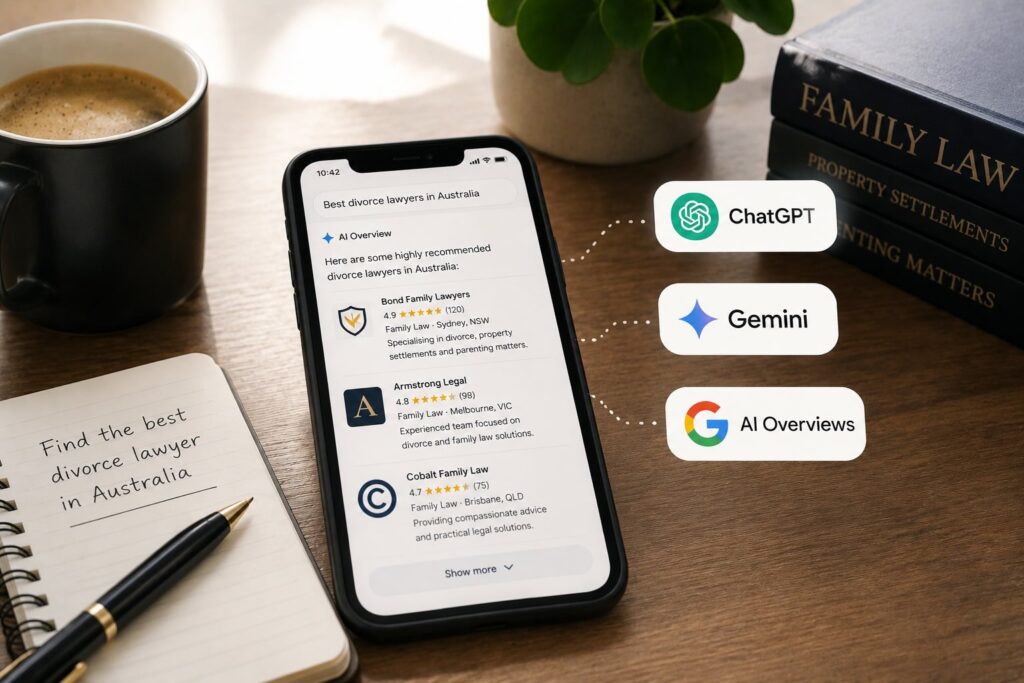
ChatGPT, Gemini, Google AI Overviews and the other AI engines recommend the divorce lawyers they can confidently trust and verify. They retrieve content from the web, then favour firms with consistent entity signals, demonstrated family law expertise, trusted citations and genuine reviews, and content structured so the answer can be extracted cleanly. They do not rank firms by keywords, and the firms they cite are not necessarily the biggest or best known. They are the ones whose digital presence is built so AI can read, trust and recommend it. Earning that recommendation requires entity clarity, citable expert content and third-party authority, the discipline known as generative engine optimisation (GEO).
Why this matters for divorce firms
Few decisions are as private or as emotionally charged as ending a marriage. The person researching is often doing it quietly, late at night, before they have told anyone.
So they do not always ask a friend for a referral. They open ChatGPT, Gemini or a Google search, type the worry they cannot yet say out loud, and read the answer. Sometimes it names firms. Sometimes it explains how to choose one. The person forms a view, and a shortlist, straight from the AI answer. Your firm is in that answer or it is not.
This sits inside the broader picture of AI SEO for law firms, but divorce raises the stakes: deep privacy, high emotion, and a high-value matter where the firm named first holds a real advantage.
How the AI engines actually recommend a lawyer
The engines apply a consistent process. They define and clean up the entity, so the firm’s identity is unambiguous. They look for trusted citations in legal publications and directories. They favour content restructured to answer the exact question directly. And throughout, they prioritise demonstrated expertise over shallow, generic answers. It is the same selection logic explored in detail in our guide to how law firms get recommended by ChatGPT.
The encouraging part is that the firms winning citations are frequently not the largest or longest established. They are the ones whose digital presence is structured so AI can interpret and trust it. That makes this a level playing field for any firm willing to do the work deliberately.
| Step | What the AI does | Where you influence it |
| 1. Retrieve | Runs a web search and pulls candidate pages | Be crawlable, indexed and present |
| 2. Define the entity | Confirms who the firm is and what it does | Keep name, location and credentials consistent everywhere |
| 3. Assess authority | Weighs citations, directories and referring domains | Earn trusted citations and listings |
| 4. Compare trust | Weighs reviews, profiles and demonstrated expertise | Publish solicitor-written, credentialed content |
| 5. Recommend | Names the firms it is most confident about | Win on clarity, authority and structure combined |
How each engine differs
Treating AI search as one channel is the most expensive mistake here. The engines cite differently, so a firm that wins one can be missing from another.
| Platform | How it recommends | Best lever for a divorce firm |
| Google AI Overviews | Displays citations prominently above results | Strong SEO and AEO foundations |
| ChatGPT | Often shows no sources, relies on Bing index and authority | Authority plus structured, extractable answers |
| Gemini | Leans on the Knowledge Graph and Google ecosystem | Entity signals, profiles and schema |
| Perplexity | Leads with visible citations, rewards fresh, sourced content | Citable, well-referenced family law content |
| Claude | Favours expert-led, trustworthy content | Credentialed, bylined solicitor content |
| Bing Copilot | Draws on the Bing index and authority | Strong Bing indexing and citations |
Only around 11% of domains are cited by both ChatGPT and Perplexity, so the right approach builds genuine authority once, then makes it legible to each engine. This is the same multi-engine reality every sector faces, explored in our guide to AI search visibility for Australian businesses.
What actually earns a recommendation: five shifts
Strip away the noise and the work that earns AI visibility for a divorce firm comes down to five things that reinforce each other.
1. Build a clear entity for your firm. AI recommends entities it recognises, not strings of keywords. Your firm must be unmistakably understood as a specific organisation, practising family and divorce law, in a specific state, staffed by named solicitors with real credentials. That means consistent name, address and phone details everywhere you appear, structured data (Organisation and LegalService schema, Person schema for each solicitor, LocalBusiness and Review markup), and internal links connecting your practice-area pages. A divorce firm in Melbourne should be tied, across the web, to “family law”, “divorce”, “parenting orders”, “property settlement” and “Victoria” with no ambiguity. This entity layer is the foundation of all AI SEO work and the most overlooked step.
2. Publish solicitor-written, citable content. Thin content does not get cited. AI rewards demonstrated expertise, so the firms that win publish real answers to the questions clients ask. Write two ways at once. First, fact density. A statement like “in Australia you must be separated for 12 months and one day before you can apply for divorce, per the Federal Circuit and Family Court of Australia” is citable. “Divorce timelines vary” is not. Second, structure for extraction. Answer the question in the first 40 to 60 words of each section, use clear headings, and add FAQ blocks for questions like “how is property divided in a divorce”, “what are parenting orders” and “how long does a divorce take”. This is answer engine optimisation applied to the questions separating clients actually ask.
3. Earn the trust signals a risk-averse AI verifies. Because AI is under pressure not to mislead, it leans heavily on what the wider web says about you. There is a pronounced trust cliff: firms with many referring domains and citations are recommended far more often than those without. For divorce law that means genuine and plentiful client reviews, verified solicitor profiles, Law Society listings, legal directories, and consistent business citations. A separating client is choosing someone to trust with their family and finances, so AI leans hard on verifiable credibility here. The firm with the strongest public record of trust is the one it feels safe naming.
4. Get into the directories and sources AI draws on. When people ask ChatGPT, Claude, Perplexity or Google AI Mode to recommend a divorce lawyer, the answer is disproportionately drawn from directories, recognised listings and authority sources. A firm cited for family law in a given city can capture nearly all the enquiries from that query. The implication is blunt: your own website is necessary but not sufficient. A complete, accurate, well-reviewed presence in the legal directories and Law Society listings your state’s clients and AI engines trust is now part of the core work, not a nice-to-have.
5. Stay current, and measure citation share. Freshness is a primary citation driver, with the large majority of AI citations going to recently published or updated pages. Keep content current as the law and your practice change, with visible update dates and consistent information everywhere. Change what you measure, too. The new KPI is citation share, how often your firm is named across AI answers for the questions that matter to your practice, not where you sit in a rankings report. Citation stability is low month to month, so this is a monitored metric, not a one-time setup. It is the same shift now redrawing SEO across every sector.
Why divorce is different from other practice areas
Privacy and emotion shape the search. Separating clients research in secret and under stress, often before telling family or friends. They trust a discreet, credible firm that answers their fears without judgement. Content written with that sensitivity earns both the client and the AI citation.
Being named first is a real advantage. Because the decision is emotional and the client wants reassurance quickly, the firm AI surfaces first is often the one contacted first. In a field where many firms look alike online, structured visibility is a genuine edge.
A privacy point worth owning. A 2026 court decision confirmed that conversations with AI tools are not protected by privilege and may be discoverable in family proceedings. Divorce firms that explain this clearly, what to share with a lawyer rather than a chatbot and why, answer a genuine client fear and earn citations for a question competitors ignore.
Compliance and AI reward the same thing. The information that satisfies a regulator is the information a risk-averse AI rewards: verifiable, accurate and not misleading. Australian advertising obligations under the Australian Solicitors’ Conduct Rules require exactly that standard. Done properly, marketing for AI and marketing within the rules are the same project.
Where does your firm appear when a separating client asks an AI for a divorce lawyer in your city? A free AI visibility audit shows exactly where you are named across ChatGPT, Perplexity, Gemini and Google AI Overviews, where competitors appear instead, and what that gap is costing you in enquiries.
A self-check you can run this week
You do not need to commit to anything to see where you stand.
List the ten to fifteen questions a client asks before choosing a divorce lawyer, in their words. For example: “how do I start a divorce in Australia”, “how is property split”, “how much does a divorce cost”. Put each one to ChatGPT, Perplexity, Gemini and Claude. Note where your firm is named, where a competitor is named, and where no local firm appears at all. Check your analytics for referral traffic from chatgpt.com and perplexity.ai, which for some firms is already arriving. Repeat it monthly, because AI answers shift with model updates.
Most firms get an uncomfortable surprise: competitors recommended for matters they assumed they owned. It pairs well with a closer look at how Google AI Overviews are reshaping the results page.
What realistic results look like
Legal decision-makers have heard inflated promises before, so it is worth being candid. Getting recommended by AI is a compounding investment, not a switch you flip. Entity clarity and content structure move faster. Domain authority, reviews and directory standing take time.
Early signs of progress are appearing in AI answers for more of your target questions and growing referral traffic from AI platforms. Over time, the goal is to be the divorce firm AI consistently surfaces in your market.
What no one can honestly offer is a guaranteed position. There is no fixed slot to buy in ChatGPT, results vary with phrasing and model updates, and cited sources churn month to month. Anyone promising a guaranteed number-one spot in an AI answer is describing something that does not exist. What proper GEO does, done well, is steadily raise the probability that your firm is the one trusted enough to recommend. Because divorce is private and high-value, the firm AI names first holds a real and compounding advantage.
Why Uprise Digital is a leading GEO partner for divorce firms
Plenty of agencies bolted AI onto their service list this past year. Far fewer understand how these systems actually select sources, and fewer still understand the privacy and emotional sensitivity that divorce work demands. That gap is where Uprise Digital works.
We treat getting your firm recommended by AI as a credibility-engineering problem, not a keyword one. The work starts with an AI visibility audit across ChatGPT, Perplexity, Gemini, Claude, Bing Copilot and Google AI Overviews, so you know exactly where your firm is named, where competitors are recommended instead, and what that gap is costing you. From there we build the entity clarity, solicitor-written extractable content, directory and third-party authority, and monthly monitoring that move the needle, all within the advertising and conduct rules Australian solicitors operate under.
It is integrated rather than bolted on. The GEO and AEO work sits on solid AI SEO foundations, connects to direct-answer visibility, and runs alongside the compliant search and conversion work we do for legal clients, supported by the wider toolkit in our overview of AI tools for digital marketing. We report honestly, on AI citations and not just Google rankings, and we will always tell you plainly what AI SEO can and cannot do. You can start at the Uprise Digital homepage or book an AI visibility audit.
How to take the next step
If you would rather not guess, the sensible first move is an AI visibility audit: a clear baseline of where you are recommended, where you are absent, and what to fix first.
The divorce firms AI recommends in 2026 are the ones doing this work in 2026, not the ones assuming their reputation and Google rankings will quietly carry over. They mostly will not.
Ready to be the divorce firm AI recommends first? Uprise Digital builds compliant AI SEO programmes that turn AI visibility into enquiries. See how we earn citations with generative engine optimisation, or explore the commercial picture in our hub on AI SEO services for law firms.
FAQ
How do ChatGPT and Gemini recommend divorce lawyers?
They retrieve content from the web, then favour firms they can verify and trust, weighing entity consistency, demonstrated family law expertise, trusted citations, reviews and clearly structured answers. They do not rank firms by keywords, and Gemini in particular leans on the Knowledge Graph and Google ecosystem.
Why is my well-known divorce firm not showing up in AI answers?
Because AI cites the firms whose digital presence it can read and trust, not necessarily the biggest or best known. Without consistent entity data, citable content and trusted citations, AI has nothing to verify, so it recommends someone else.
Do the AI engines recommend differently?
Yes. Google AI Overviews displays citations prominently, Perplexity leads with citations, and ChatGPT often shows none. Only around 11% of domains are cited by both ChatGPT and Perplexity, so firms must build for each engine their clients use.
What content helps a divorce lawyer get cited by AI?
Solicitor-written content with jurisdiction-specific references, clear structure, and direct answers to real client questions about divorce, property settlement and parenting. AI validates expertise through proper grounding, so generic practice-area pages rarely get cited.
How do I measure AI visibility if there is no click?
Through citation share: regularly prompting the major AI engines with your real client questions and recording whether your firm appears, who appears instead, and what they are cited for. A good agency reports this monthly rather than only showing Google rankings.
Is it true that AI chats can be used in a divorce case?
A 2026 court decision confirmed that conversations with AI tools are not protected by privilege and may be discoverable. It is a real client concern, and firms that address it clearly in their content build trust and earn citations.
Why choose an Australian AI SEO agency for a divorce firm?
US sources are cited far more often than non-US ones, and family law is governed federally but advised locally, so Australian firms need deliberate local entity signals, jurisdiction detail and an agency that understands Australian solicitor advertising rules to be recommended in their own market.
Key takeaways
- AI engines recommend firms they can verify, weighing entity consistency, demonstrated expertise, trusted citations and reviews, not keywords.
- The firms getting cited are often not the biggest or best known, but the ones whose digital presence AI can actually read and trust.
- The engines behave differently: Google AI Overviews displays citations prominently, Perplexity leads with citations, and ChatGPT often shows none, so firms must build for each.
- Divorce is emotional and private. Many people research late at night and will not ask anyone they know, which makes the AI answer their first and most trusted source.
- A 2026 court decision confirmed that conversations with AI tools are not protected by privilege and can be discoverable, a real client fear that firms can answer in content and earn citations for.
- Getting recommended is a compounding GEO discipline: entity clarity, citable expert content, third-party authority and monthly monitoring.
Resources
These external sources inform the data and claims in this article, and are useful authority references on AI search and family law:
- Google, Generative AI in Search guidance: official documentation on AI Overviews and AI features in Search.
- OpenAI: primary source on ChatGPT search and how the assistant retrieves and cites the web.
- Google, Gemini and the Knowledge Graph: announcements on Gemini and how Google surfaces AI answers.
- Federal Circuit and Family Court of Australia: the official authority on divorce, separation periods and family law process.
- Law Council of Australia: the Australian Solicitors’ Conduct Rules that govern legal advertising.
- Gartner Newsroom: forecast that traditional search volume will fall around 25% by 2026.
- Wikipedia, Zero-click search: background on the zero-click phenomenon.