
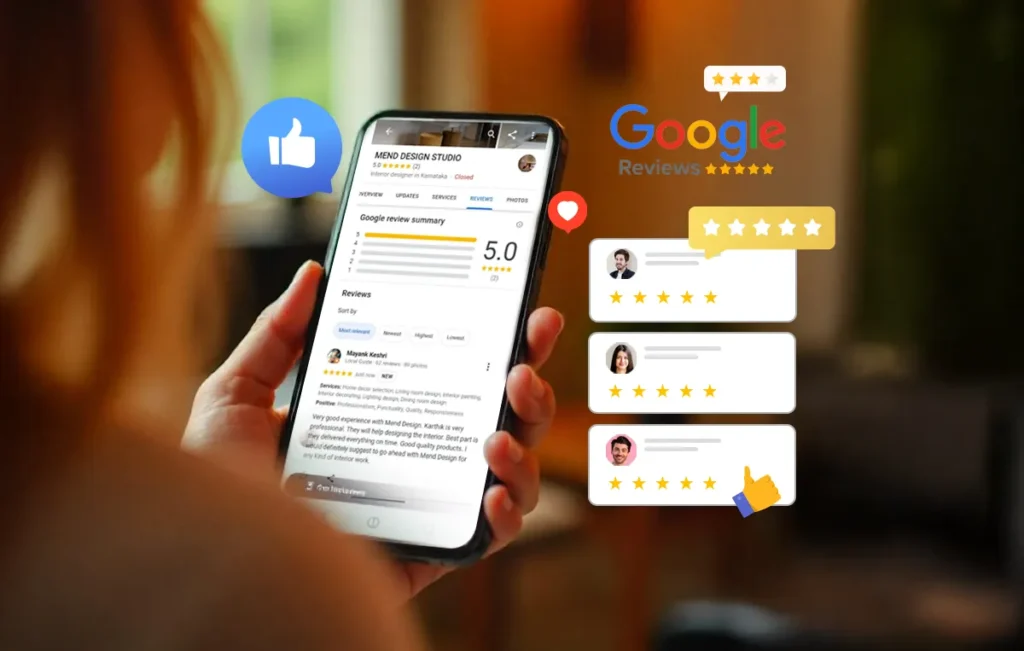
Handing money to a builder is the largest and most nerve-wracking purchase most Australians ever make. It is paid in stages, over a long period, for something that does not exist yet, by someone who cannot judge whether the work is being done properly. Builder collapses have been in the news for years, and every client has heard a story from a friend about a build that went badly.
Reviews are how people manage that fear. They are not a nice extra for a building company. For many clients they are the deciding factor, and they are now being read by AI assistants as well as by humans.
Key takeaways
- Builders have a slow, lumpy review cycle because builds take a long time, so reviews have to be built into the job rather than chased at the end.
- A detailed review that names the type of build and the area is worth far more than a short five star rating.
- How you reply to a bad review is read more closely than the review itself.
- Offering anything in exchange for a positive review, or filtering who gets asked, can breach Australian Consumer Law.
- AI assistants pull from review platforms and public forums when they recommend builders, so your reputation now feeds directly into whether you get named at all.
Why builders have it harder than other trades
An electrician might complete several jobs a week. Every one is a chance to ask for a review, and a busy sparky can build a large, recent, steady stream of them without much effort.
A builder might hand over a handful of homes in a year. That creates three problems at once. You have far fewer opportunities to ask. The gap between a client signing and being able to review you is enormous. And because the relationship runs so long, the review reflects the whole experience rather than a single visit, which means a good build with a frustrating middle stretch can still produce a lukewarm review.
Builders also carry emotional weight that other trades do not. Clients are stressed, stretched financially, often living somewhere temporary and waiting far longer than they expected. Delays that are genuinely outside your control still feel like your fault to someone paying rent and a mortgage at the same time.
None of that is fixable. It just means the approach that works for a plumber does not transfer, and asking once at handover is not enough.
Ask along the way, not just at the end
Handover is the traditional moment to ask, and it is often the worst one. The client is exhausted, focused on the defects list, and dealing with moving. Asking for a favour at that exact moment does not go well.
The better approach treats the build as a series of moments where a client feels genuinely positive, and asks near one of those instead.
- After the design and contract stage, when the client has just seen their plans come together and is excited rather than tired.
- At lock-up, when the house first looks like a house. This is often the emotional high point of the whole build.
- A few months after handover, once the defects are resolved and they are settled in and enjoying the home rather than managing a project.
The last one is the most underused. A client three months into living somewhere they love will write you something far warmer than the same client on handover day. It also gives you an honest way to mention it: you are asking now that they have had time to settle in.
Whoever has the actual relationship should do the asking. A message from the site supervisor the client has spoken to every week gets answered. A generic email from the company does not.
Is this you?
If any of these sound familiar, the Builder's Growth Playbook was written for you.
- Architect referrals have slowed to a trickle and you don't own your pipeline
- You've tried Instagram, videographers, or Google Ads and got noise, not clients
- You know your work is better than the builder who got the job
Ask for the detail, not the stars
Most reviews are short because most people freeze when asked to write one. They give five stars and a sentence, and that sentence is usually something like “great team, highly recommend”.
That review does very little. It does not tell a future client that you build the kind of home they want, in the area they want it, or that you handled something difficult well.
The fix is to ask a question rather than request a review. Rather than asking someone to leave a review, ask what stood out about the build, or how they found the process compared to what they expected. People answer questions easily. They stall on blank boxes.
You must never tell a client what to write or steer them towards specific claims. But there is nothing wrong with prompting a memory. Mentioning that you would love to hear their thoughts on how the sloping block was handled, or on the extension living alongside the original house, gives them a real starting point. What they then choose to say is entirely theirs.
Where builder reviews actually count
Not every platform matters equally, and spreading yourself across all of them thinly is worse than doing three properly.
| Where | Why it matters |
|---|---|
| Google Business Profile | The default. It shows next to your listing, feeds the map results, and is the first thing most people check. |
| Independent review platforms | Australians researching a large purchase often check these specifically, and AI assistants pull from them. |
| Home and design directories | Where people browsing for design inspiration end up, and useful for custom and high-end work. |
| Industry association listings | Fewer reviews, but strong trust signals because membership is verifiable. |
| Public forums and community groups | You cannot control these, but they get read by people and by AI assistants alike. |
When we tested how AI assistants shortlist builders, review platforms, directories and a public forum thread all appeared as sources behind the recommendations. An unclaimed or empty profile on one of those is a gap in how you are described. Our study of how AI decides which builders to recommend shows exactly which types of source were used. Making sure those sources describe you accurately and consistently is a core part of GEO, the work of getting your building company into AI answers.
Replying to a bad review
Every builder gets one eventually. Long projects, large sums and high stress guarantee it. A negative review does far less damage than most builders fear. A defensive reply does far more than most builders realise.
Assume the reader is a prospective client comparing you against two others. They are not trying to work out who was right. They are trying to work out what you are like when something goes wrong, because they know something will.
- Wait before replying. Nothing good has ever been written in the first hour after reading a review like that.
- Keep it short. A long reply looks like a fight. A brief, calm one looks like a business that handles things.
- Do not argue the timeline in public. Correcting each point makes you look combative even when you are right.
- Acknowledge the experience without accepting claims that are untrue. You can say you are sorry it felt that way and that you take it seriously without agreeing to a version of events you dispute.
- Move it offline. Offer a direct contact and a real name.
- Never share private details. Not the contract, not the payments, not their personal circumstances. It is a serious breach of trust and every reader will see it that way.
Where a review is genuinely false or came from someone who was never a client, both the platform’s reporting process and, in serious cases, legal advice are the right routes. Australian defamation law is complicated and threatening a client publicly tends to make things far worse. Get advice before going anywhere near that path.
One more thing worth remembering. A profile with nothing but perfect reviews reads as suspicious to experienced buyers. A handful of mixed reviews handled gracefully often does more for trust than an unbroken wall of five stars.
What not to do
This is the part where builders get into genuine trouble, usually after being sold a service that promises easy results.
- Do not buy reviews or have staff, family or subcontractors write them. Fake reviews mislead consumers and breach Australian Consumer Law. The regulator has pursued businesses over this, and platforms remove them.
- Do not offer anything in exchange for a positive review. Discounts, upgrades, gift cards or entry into a draw conditional on leaving a good review all create a misleading picture.
- Do not filter who you ask. Surveying clients first and only sending the happy ones to a review platform is called review gating. Platforms prohibit it and it misrepresents your business.
- Do not make a review a condition of anything. Never link it to finishing defects, releasing documents or any part of the contract.
- Do not delete or hide unfavourable reviews you control. Removing critical feedback from your own site while keeping the positive ones is misleading.
Asking every client, at a good moment, in a way that makes it easy to answer is entirely legitimate and is all you actually need.
Put your reviews to work
Most builders collect reviews and leave them sitting on the platform where they were written. They are more useful than that.
- Put reviews from a given area on the page for that area, so someone reading about your work in their suburb sees a neighbour’s words.
- Put reviews about a job type on that job type’s page. A review about an extension belongs on the extensions page.
- Attach the review to the project page for that build, next to the photographs of the finished work.
- Read them for patterns. If several clients praise the same thing, that is your genuine strength and it belongs in how you describe yourself. If several raise the same frustration, that is a process problem worth fixing.
Always attribute quotes properly and use them with permission. Reproducing a review in full with the client’s first name and suburb, as they wrote it, is fine. Editing it into something more flattering is not.
Free Download
The Builder’s Growth Playbook
- The system builders use to turn $50k in ad spend into $5M to $15M in contracted work
- Why the best clients in your market are choosing builders worse than you
- The five mistakes that destroy the result before it has a chance to work
Frequently asked questions
How many reviews does a builder need?
There is no target worth chasing. What matters more is that they are recent, that they describe real builds, and that there are enough of them to look like a pattern rather than a handful of friends. Given how few homes most builders hand over in a year, steady beats sudden.
Can I ask a client who had a difficult build?
You can, and sometimes you should, provided the issues were genuinely resolved. A review describing a problem and how you fixed it can be more persuasive than a glowing one, because it answers the question every prospective client is silently asking. Use your judgement and never pressure anyone.
What if a competitor is leaving fake reviews?
Report it through the platform with whatever evidence you have, such as no record of the person as a client. Keep your public reply calm and factual. Do not accuse anyone publicly, because if you are wrong you have created a much larger problem than the review.
Do reviews help with search rankings?
They contribute to local visibility, and they strongly affect whether someone clicks you rather than the builder above you. The bigger effect is on conversion. Two builders can rank side by side and the one with recent, detailed reviews gets the call.
Why would an AI assistant care about my reviews?
Assistants look for other sources that back up what a business says about itself. Reviews are one of the few sources written by someone other than you. When we traced the sources behind AI builder recommendations, review platforms and forums appeared repeatedly alongside builder websites.
Want to know what people find when they check you out?
We will look at what shows up about your building company across search, review platforms and AI assistants, and show you what a cautious client sees before they call. Book a free strategy session and we will go through it with you.
Our guides to SEO for builders and builder website design cover where those reviews do the most work, and our construction marketing page shows how we work with building companies.