
TLDR: Google Ads Quality Score is a 1 to 10 rating built from expected click-through rate, ad relevance and landing page experience. Lifting your Quality Score from 5 to 8 typically cuts CPC by 30 to 50 percent. The fastest wins are tighter ad groups (one keyword theme each), keyword-matched headlines, and a landing page that mirrors the ad message and loads under 2 seconds. Negative keywords protect score over time.
Two Australian businesses can bid on the exact same keyword, in the same city, at the same time, and pay dramatically different prices per click. One might pay $4. The other might pay $12. The difference is not budget, not bid strategy, not campaign size. The difference is Quality Score.
Quality Score is Google’s rating of how relevant your ads, keywords, and landing pages are to the searchers seeing them. It is measured from 1 to 10. A Quality Score of 8 to 10 can reduce your actual cost per click by 30 to 50% compared to average. A Quality Score of 1 to 3 can double or even triple it. If your Google Ads costs keep climbing and you cannot figure out why, there is a very good chance your Quality Score is the reason.
Here I’ll break down what Quality Score actually is, why Google weighs it so heavily, and the practical moves Australian businesses can make to improve it.
The goal is simple: pay less for the same clicks, outperform competitors with bigger budgets, and stretch every ad dollar further.
What Quality Score Actually Is
Quality Score is a diagnostic number Google assigns to each keyword in your account, shown on a scale of 1 to 10. It reflects Google’s estimate of how likely searchers are to have a good experience when they see your ad and click through to your landing page.
Google’s logic is straightforward. If ads on the search results page are relevant and helpful, users keep coming back. If ads are irrelevant or the landing pages are slow and confusing, users trust Google less. So Google rewards advertisers who provide good experiences by charging them less, and penalises advertisers who waste searchers’ time by charging them more.
This is why Quality Score matters so much for Australian businesses running Google Ads. A competitor with a bigger budget but a lower Quality Score can be outbid by a smaller business with a higher Quality Score. In the Google Ads auction, relevance beats raw spending power. If you have ever wondered how a local Sydney tradie outranks a national chain on the same keyword, Quality Score is usually the answer.
It is worth being clear about what Quality Score is not. It is not the same as Ad Strength, which is a separate diagnostic about how well you have filled out your responsive search ads. It is not Optimization Score, which measures how many Google recommendations you have accepted. Quality Score is the metric that actually influences what you pay per click, and it is the one worth focusing on.
The Three Components of Quality Score
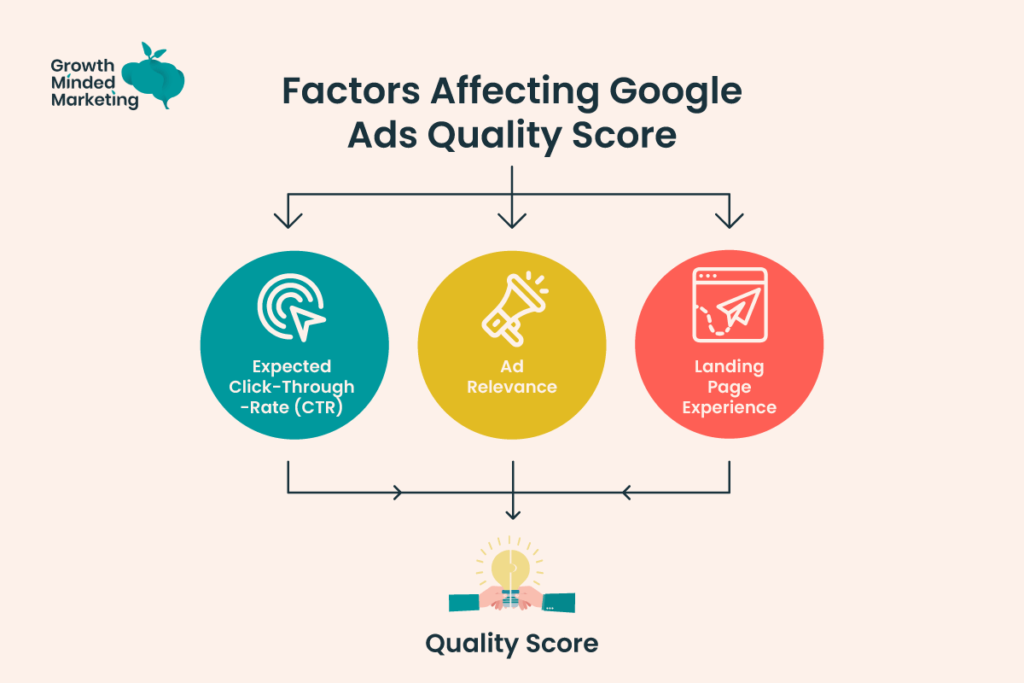
Google calculates Quality Score from three components, each rated as Above Average, Average, or Below Average. Understanding how each works is the first step to improving your score.
| Component | What Google Measures | How to Improve It |
| Expected CTR | How likely your ad is to be clicked when it shows for a specific keyword | Better headlines, stronger offers, closer match between keyword and ad copy |
| Ad Relevance | How closely your ad matches the intent behind the keyword | Tighter ad groups, keyword-in-headline, fewer themes per ad group |
| Landing Page Experience | How useful, fast, and relevant your landing page is to the visitor | Service-specific pages, fast load speeds, mobile design, clear CTA |
Of these three, landing page experience is typically the fastest and most impactful to improve because it is the most commonly neglected. Most Australian businesses running Google Ads send all their paid traffic to their homepage, which tries to serve every audience at once and is therefore relevant to none of them specifically. A dedicated landing page built around a single service, with the keyword reflected in the headline and a clear call to action, can lift Quality Score significantly within a few weeks. Landing page optimisation is where the biggest Quality Score wins usually come from.
How Quality Score Actually Affects Your CPC
Google does not publish a precise formula, but the accepted industry estimates make the financial impact of Quality Score very clear. A keyword with a Quality Score of 10 receives a substantial discount on its cost per click compared to one with a Quality Score of 5. A keyword with a Quality Score of 1 or 2 can pay 150 to 400% more per click than an advertiser with an average score. If your keyword status shows “Rarely shown (low Quality Score),” Google may decide not to show your ads at all, regardless of how much you bid.
Here is what that looks like in practice. Imagine you are bidding on “emergency electrician Sydney” with a maximum CPC of $20. If your Quality Score is 10, you might actually pay $8 per click. If your Quality Score drops to 4, that same click could cost $25, which means Google will not even serve your ad if your max bid is capped at $20. Your budget disappears faster, you get fewer clicks, and your competitors with better Quality Scores dominate the auction. The compounding effect on your return on ad spend over a month is enormous.
How to Improve Quality Score in Practice
Improving Quality Score is not about chasing a 10 out of 10 on every keyword. It is about fixing the structural issues in your account that Google interprets as signs of low relevance. In order of impact, here is what to work on.
Start with your account structure. Tight ad groups beat broad ones. If one ad group targets “emergency electrician,” “switchboard upgrade,” and “EV charger installation” with the same set of ads, your ad relevance will suffer because no single ad can match all three search intents well. Split those into separate ad groups, each with keywords that share a single theme and ads that directly address that theme. This alone is often enough to lift ad relevance from Below Average to Above Average within a couple of weeks.
Rewrite your ad copy to include the keyword in the headline. Google’s system weights keyword-in-headline heavily for both expected CTR and ad relevance. If your keyword is “commercial electrician Brisbane,” your ad headline should include those exact words, not a generic “Professional Electrical Services.” Use all 15 headline slots and four description slots in responsive search ads. The more combinations Google has to test, the faster it finds the ones that resonate with searchers, which improves your click-through rate and therefore your expected CTR score.
Build dedicated landing pages for each major service or campaign. The homepage approach is one of the most expensive mistakes in Google Ads, and it is covered in detail in our guide to the 7 Google Ads mistakes that cost Australian businesses thousands. A landing page for “dental implants Melbourne” should talk about dental implants in Melbourne, match the language of the ad, load in under three seconds, work perfectly on mobile, and have one clear conversion action. Everything else is noise that drags your landing page experience score down.
Add negative keywords aggressively. If your ads are showing on irrelevant searches, you get low click-through rates on those impressions, which drags down your expected CTR score across the entire account. Review your search terms report weekly and add negatives for any queries that do not match your services. This is one of the simplest changes you can make and one of the most immediately effective.
Pause low-performing ads. If an ad has generated hundreds of impressions but very few clicks, keep it running and it will continue dragging down your expected CTR. Google needs to see that your ads earn clicks to reward you with Quality Score. Keep two to three active ads per ad group, test them against each other, and pause the losers.
When Quality Score Matters Less
Quality Score is a Search campaign metric. In Performance Max and other automation-heavy campaign types, the system optimises based on conversion signals rather than keyword-level Quality Scores, so the visible score matters less. Broad match campaigns also tend to show lower Quality Scores simply because they trigger for a wider range of searches, which is not automatically a problem if the campaign is delivering on ROAS.
If your account is hitting efficiency targets and scaling profitably, restructuring everything to chase a better Quality Score is rarely worth the effort. The goal is not a perfect score. The goal is profitable campaigns that win the auctions that matter for your business. Quality Score is one of the most reliable signals that your account has structural problems worth fixing, but it is not the only thing that defines success.
Final Thoughts
Quality Score is the single biggest lever most Australian businesses have for reducing their Google Ads costs without reducing their lead volume. A 2-point improvement in Quality Score across your top-spending keywords can cut your effective CPC by 20 to 30%, which over a year of ad spend can mean tens of thousands of dollars saved or redirected into more impressions and more leads.
The work is not complicated. Tighten your ad groups, write ads that include the keyword in the headline, build dedicated landing pages for each service, add negative keywords every week, and pause the ads that are not earning clicks. Do that consistently and Google will reward you with lower costs and better ad positions. Ignore it, and you will keep paying your competitors’ tax for no reason.
If you want a clear audit of where your current campaigns are leaking budget to low Quality Scores, book a free strategy call with our team. We will walk through your account and show you exactly which changes will have the biggest impact on your cost per lead.