
If you run a service business in Australia and manage your own Google Ads, or if your agency has recently suggested switching to Performance Max, you are probably asking the same question everyone else is: does this thing actually work for businesses that generate leads, not online sales?
The honest answer? It depends. And the reason it depends is something most of the Performance Max content online completely ignores: nearly all PMax advice is written for e-commerce. Product feeds, ROAS targets, shopping ads, transaction tracking. That is a completely different world from a plumber in Parramatta trying to fill next week’s job sheet or a migration agent in Melbourne chasing qualified consultations.
Performance Max is now the default campaign type Google pushes to every advertiser. Over 73% of Google Ads accounts run at least one PMax campaign. But being popular does not mean it is the right choice for your business.
This guide breaks down what Performance Max actually does, where it works for Australian service businesses, where it falls apart, and how to set it up properly if you decide to use it.
What Is Performance Max (and Why Is Google Pushing It So Hard)?
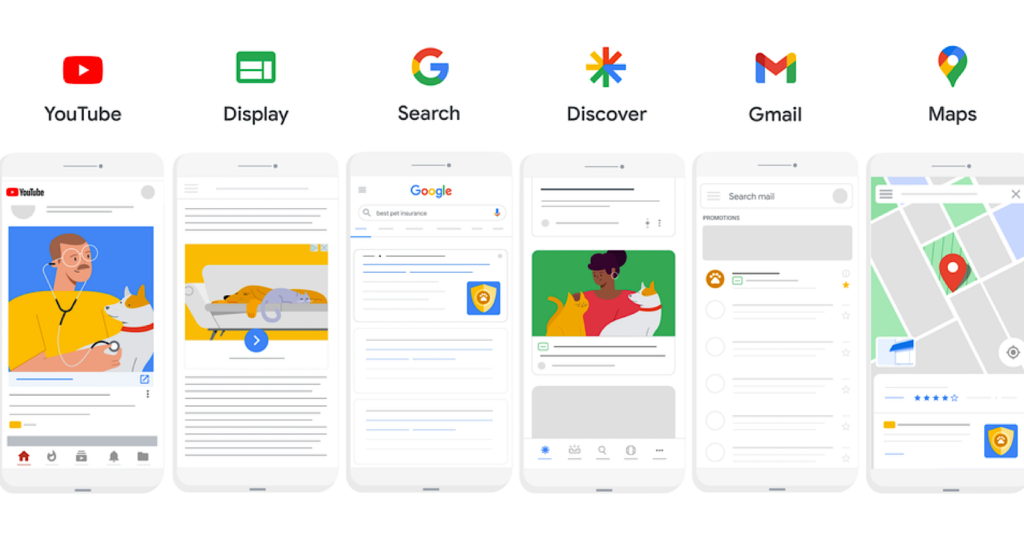
Performance Max is a goal-based, AI-driven campaign type that runs your ads across every Google channel simultaneously: Search, Display, YouTube, Gmail, Discover, and Maps. Instead of building separate campaigns for each channel, you give Google a budget, a conversion goal, some creative assets, and audience signals. Google’s machine learning then decides where to show your ads, who to show them to, and how much to bid.
Google launched PMax in late 2021 and forcibly migrated Smart Shopping and Local campaigns into it in 2022. By 2025, they introduced the “Power Pack” strategy, pairing PMax with Demand Gen and AI Max for Search as the recommended campaign structure for all advertisers.
The appeal is obvious: one campaign, all channels, less management. For time-poor business owners who do not want to manage five separate campaign types, the simplicity is genuinely attractive.
But here is the catch. Performance Max was built for e-commerce first. Its entire architecture is optimised for businesses with product feeds, transaction data, and clear purchase values. When you sell a $200 product online, Google can see exactly what happened: the click, the purchase, the revenue. The algorithm learns fast and optimises well.
For service businesses, the picture is murkier. Your “conversion” is a phone call, a form submission, or an online booking. Google cannot see whether that call turned into a $5,000 job or a tyre-kicker who hung up after 10 seconds. And that gap between what Google can track and what actually makes you money is where Performance Max either thrives or wastes your budget.
The Lead Quality Problem: Why PMax Struggles With Service Businesses
This is the single biggest issue with Performance Max for lead generation, and it is the one most agencies and Google’s own documentation gloss over.
Search Engine Land has been particularly direct on this point: getting Performance Max to work for lead generation without offline conversion data is very hard. If your conversion tracking fires on a thank-you page load rather than an actual qualified submission, PMax will optimise for volume, not quality. It will find you the cheapest clicks that technically “convert,” but those conversions might be spam submissions, accidental form fills, or tyre-kickers who never answer the phone when you call back.
An Optmyzr study across 503 Google Ads accounts found that 91.45% of accounts had keyword overlap between Search campaigns and Performance Max. In those overlap scenarios, Search campaigns won on conversion performance nearly twice as often. This means a significant portion of PMax’s reported conversions may not be truly incremental. They are conversions your Search campaigns would have captured anyway, often with better quality.
For Australian service businesses, this creates a specific risk. You might look at your PMax dashboard and see 30 conversions at $50 each. Looks great. But if 15 of those are low-quality leads that never book, your real cost per acquired customer is $100, and your Search campaigns would have delivered 20 leads at $60 each with a much higher close rate.
This is exactly the kind of trap covered in our guide on the 7 Google Ads mistakes that cost you thousands. Optimising for the wrong metric is one of the most expensive errors a service business can make.
Where Performance Max Actually Works for Service Businesses
To be fair, PMax is not all bad for lead generation. There are specific scenarios where it can deliver genuine value for Australian service businesses.
When You Have Offline Conversion Tracking Set Up
If you feed PMax data about which leads actually became paying customers (through CRM integration or offline conversion imports), the algorithm can learn what a good lead looks like and optimise toward it. This is the difference between telling Google “get me form submissions” and telling Google “get me form submissions that turn into $5,000 jobs.” The second instruction produces dramatically better results.
Most Australian service businesses do not have this set up. But if you do, PMax becomes a much more powerful tool.
When You Need Brand Visibility Across Multiple Channels
If your business operates in a competitive local market and you want your name showing up across Search, YouTube, Gmail, Maps, and the Display Network without managing five separate campaigns, PMax consolidates that presence efficiently. For businesses where brand awareness and conversion campaigns need to work together, PMax can serve as the awareness layer while dedicated Search campaigns handle high-intent queries.
When Your Budget Is Large Enough to Feed the Algorithm
PMax needs data to learn. Google recommends campaigns generate at least 30 conversions in a 30-day period for optimal performance. For a service business spending $1,500 to $3,000 per month, that threshold can be hard to reach. If your budget is $5,000 or more per month and your cost per lead allows for sufficient conversion volume, PMax has enough signal to optimise effectively.
Below that threshold, a well-structured Search campaign will almost always outperform PMax for service businesses.
Performance Max vs Standard Search: Which Is Better for Leads?
| Factor | Performance Max | Standard Search Campaign |
| Targeting control | Limited. Google decides placements and audiences based on signals. | Full control over keywords, match types, and negative keywords. |
| Lead quality | Variable. Often lower without offline conversion data. | Generally higher. Targets explicit search intent. |
| Channel reach | All Google channels (Search, YouTube, Display, Gmail, Maps, Discover). | Search results only. |
| Budget requirement | Needs 30+ conversions/month for optimal learning. | Can work effectively with smaller budgets. |
| Transparency | Limited search term visibility. Cannot see full keyword data. | Full search term reports. Clear keyword-level performance. |
| Best for | Multi-channel visibility, brand awareness, large budgets with CRM data. | High-intent lead generation, local service queries, smaller budgets. |
| Setup complexity | Easier setup, but harder to diagnose and fix problems. | More initial setup, but granular control for ongoing optimisation. |
For most Australian service businesses, especially those spending under $5,000 per month, a well-structured Search campaign targeting high-intent keywords like “[service] near me” or “[service] [suburb]” will outperform Performance Max on lead quality and cost per acquired customer. The transparency of Search campaigns also makes it much easier to identify what is working and what needs fixing.
If You Do Run Performance Max: How to Set It Up for Lead Generation
If you have the budget, the conversion tracking infrastructure, and a genuine need for multi-channel visibility, here is how to structure PMax for an Australian service business without wasting money.
1. Get Your Conversion Tracking Right First
This is non-negotiable. Before launching PMax, make sure your conversion tracking is airtight.
- Track phone calls with a minimum 60-second duration to filter out accidental dials and tyre-kickers.
- Track form submissions on actual thank-you page loads, not button clicks.
- Set up Enhanced Conversions to supplement cookie data with hashed first-party information.
- If possible, import offline conversion data from your CRM so Google can learn which leads actually became paying customers.
Without this foundation, PMax will optimise toward the cheapest “conversions” it can find, and those will not be the phone calls that book $10,000 jobs. Your landing pages need to be set up properly before you point any paid traffic at them.
2. Segment by Campaign Objective
Do not throw everything into one campaign. For a service business, a practical segmentation looks like:
- Campaign 1: New Customer Acquisition. Target cold audiences, optimise for qualified lead form submissions or 60-second phone calls, use prospecting audience signals.
- Campaign 2: Retargeting. Target past website visitors and people who called but did not book, optimise for high-intent form fills or repeat calls.
- Campaign 3: Brand Protection. Ensure your business shows up across all Google surfaces when people search for your brand name. This prevents competitors from intercepting your branded traffic.
3. Use Audience Signals Aggressively
Audience signals are not targeting restrictions in PMax. They are suggestions that help Google’s algorithm learn faster. For service businesses, the most effective signals include:
- Customer match lists: upload your existing customer email and phone lists so Google can find similar users.
- Website visitors from the last 30 to 90 days.
- In-market segments relevant to your services (e.g., “Home Services,” “Legal Services,” “Health and Medical”).
- Custom intent audiences built from high-converting search terms in your existing campaigns.
4. Provide Quality Creative Assets
PMax is a visual-first platform. If you do not upload high-quality images and at least one video, Google will auto-generate them from your assets, and the results are usually terrible. For a service business, this means professional photos of your team, your work, your premises, and short-form videos (6 to 15 seconds) showing your service in action.
Load your asset groups to full capacity: at least 15 images, 5 headlines, 5 descriptions, your logo, and one or more videos. The more assets you provide, the more combinations Google can test.
5. Run PMax Alongside Search, Never Instead of It
This is the most important structural decision. Performance Max should complement your Search campaigns, not replace them. Your Search campaigns capture high-intent queries where someone is actively looking for your service right now. PMax extends your reach to users earlier in the journey across YouTube, Display, and Discover.
Google’s 2025 “Power Pack” framework recommends running PMax alongside AI Max for Search and Demand Gen. For most Australian service businesses, a simpler version works: a strong Search campaign handling your core service and location keywords, plus a PMax campaign handling multi-channel reach and retargeting. If you are not sure how to balance spend between the two, try our PPC ROI calculator to model the numbers.
The Verdict: PMax by Service Industry in Australia
| Industry | PMax Verdict | Why |
| Tradies (plumbers, electricians, builders) | Use with caution | High-intent local search is your bread and butter. Search campaigns should take priority. PMax works as a brand awareness add-on if budget allows. |
| Solar installers | Can work well | Longer decision cycle suits PMax multi-touch approach. YouTube and Display build consideration before Search captures the lead. |
| Healthcare / dental | Use with caution | Local intent is dominant. Search + Local campaigns outperform. PMax can supplement for elective/cosmetic services with longer research phases. |
| Legal / migration | Limited use | Very high CPC keywords need precise targeting. Search gives you the control PMax cannot. Lead quality concerns are amplified at $20 to $50+ per click. |
| Real estate / property | Can work well | Multi-channel visibility important for brand building. YouTube tours and Display retargeting align well with PMax strengths. |
| Gyms / fitness | Good fit | Visual service, strong local intent, high-volume conversions. PMax can drive trial sign-ups efficiently across channels. |
The Bottom Line: Should Your Service Business Use Performance Max?
Performance Max is a powerful tool in the right hands and with the right business setup. But for the average Australian service business spending $1,500 to $4,000 per month on Google Ads, a well-built Search campaign will deliver more qualified leads at a lower cost per acquisition with far more transparency into what is actually working.
PMax earns its place when you have robust conversion tracking (ideally with offline data), a budget large enough to generate 30+ conversions per month, quality creative assets, and a clear understanding of how it fits alongside your Search campaigns. Without those foundations, it is more likely to drain your budget across low-value Display and YouTube placements than fill your appointment book.
The businesses that get the best results from Google Ads in 2026 are not the ones blindly adopting whatever Google recommends. They are the ones who understand which campaign types serve which purpose and build a structure that matches their actual business goals. That starts with understanding whether Google Ads or Facebook Ads are the right fit in the first place, and then choosing the right campaign types within each platform.
Not Sure Which Campaign Type Is Right for Your Business?
At Uprise Digital, we specialise in Google Ads for Australian service businesses. We do not default to Performance Max because Google recommends it. We build campaign structures based on what will actually deliver the best leads and the lowest cost per acquired customer for your specific business.
Whether you need a Search-first strategy, a PMax setup with proper offline tracking, or a complete audit of campaigns that are not performing, book a free strategy call and we will show you exactly where your budget should go.
FAQs
Is Performance Max better than Search campaigns for lead generation?
Not usually. For service businesses, Search campaigns targeting high-intent keywords consistently deliver higher quality leads with more transparency. PMax can complement Search for multi-channel visibility, but it should not replace it. The data shows that Search campaigns outperform PMax on conversion quality in over half of accounts with keyword overlap.
How much budget does Performance Max need to work?
Google recommends generating at least 30 conversions per month for optimal PMax learning. For most Australian service businesses, that requires a monthly ad spend of at least $3,000 to $5,000, depending on your industry and cost per lead. Below that threshold, Search campaigns are more efficient.
Can I run Performance Max and Search campaigns at the same time?
Yes, and you should. Google’s own best practice is to run PMax alongside Search campaigns. Your Search campaigns capture high-intent queries while PMax extends reach across YouTube, Display, Gmail, and Discover. The key is to monitor for keyword overlap and ensure PMax is not cannibalising conversions your Search campaigns would have captured anyway.
Why does Performance Max generate low-quality leads?
PMax optimises toward whatever conversion goal you give it. If you track form submissions without filtering for quality, PMax will find the cheapest way to generate form submissions, which often means low-intent users on Display and Discover placements. The fix is to track only high-value conversions (60-second phone calls, qualified form submissions) and ideally import offline conversion data from your CRM.
What is the biggest mistake service businesses make with PMax?
Using PMax as their only campaign type and tracking the wrong conversions. This combination leads to inflated lead numbers with poor actual close rates. The best approach is to run PMax as a complement to Search, with tight conversion tracking that reflects real business outcomes. You can read more about this and other costly errors in our guide to the 7 Google Ads mistakes that cost you thousands.
Related Reading
Google Ads vs Facebook Ads: Which Is Better for Your Business?
Why Google Ads Fail: 7 Mistakes That Cost You Thousands
Landing Page Optimisation: The Complete Guide
Awareness or Conversion Campaigns: Where Should You Spend?
How to Choose a Digital Marketing Agency in Australia